Victoria Cross · Rossignol Wood, France · 1918
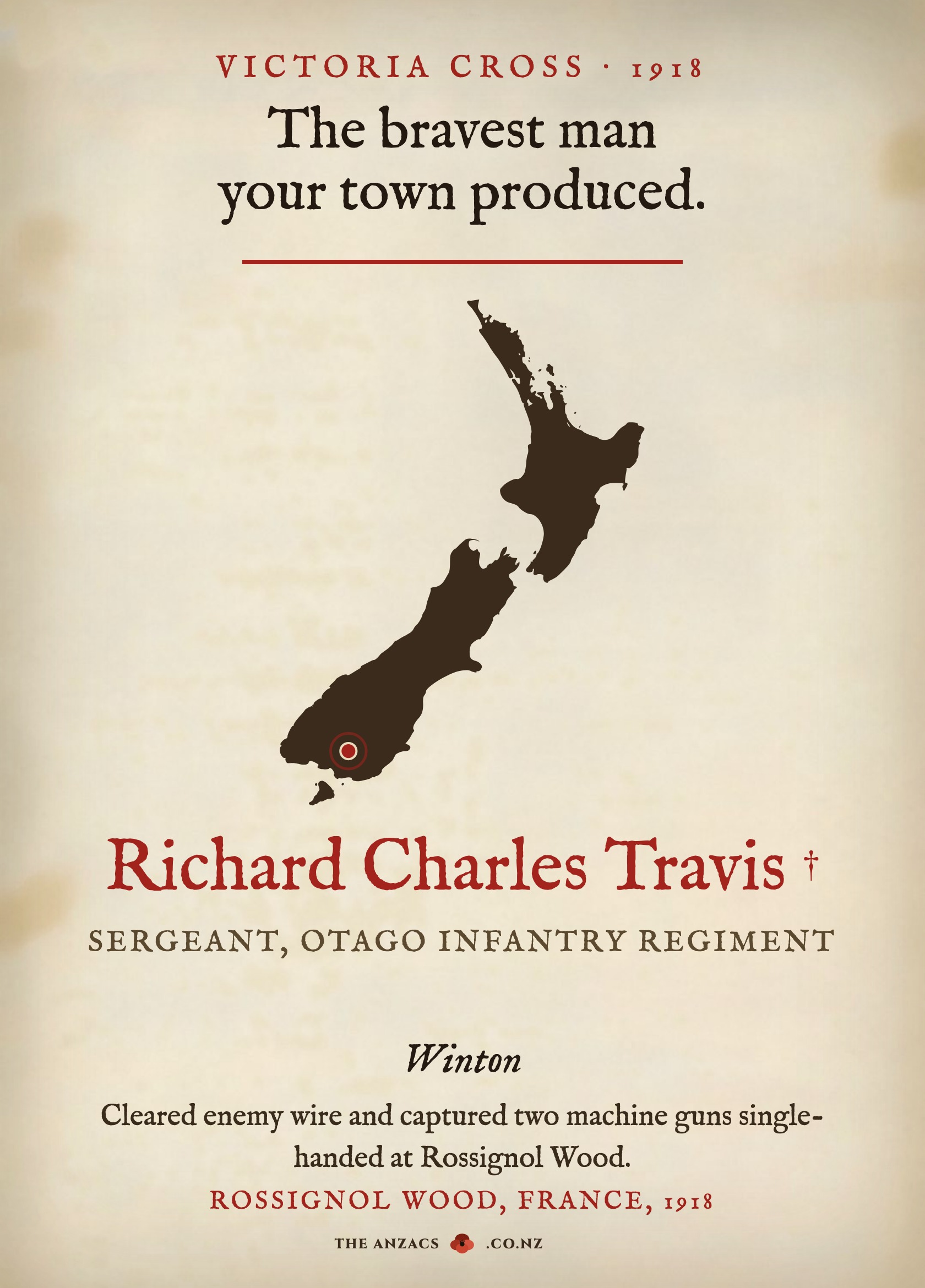
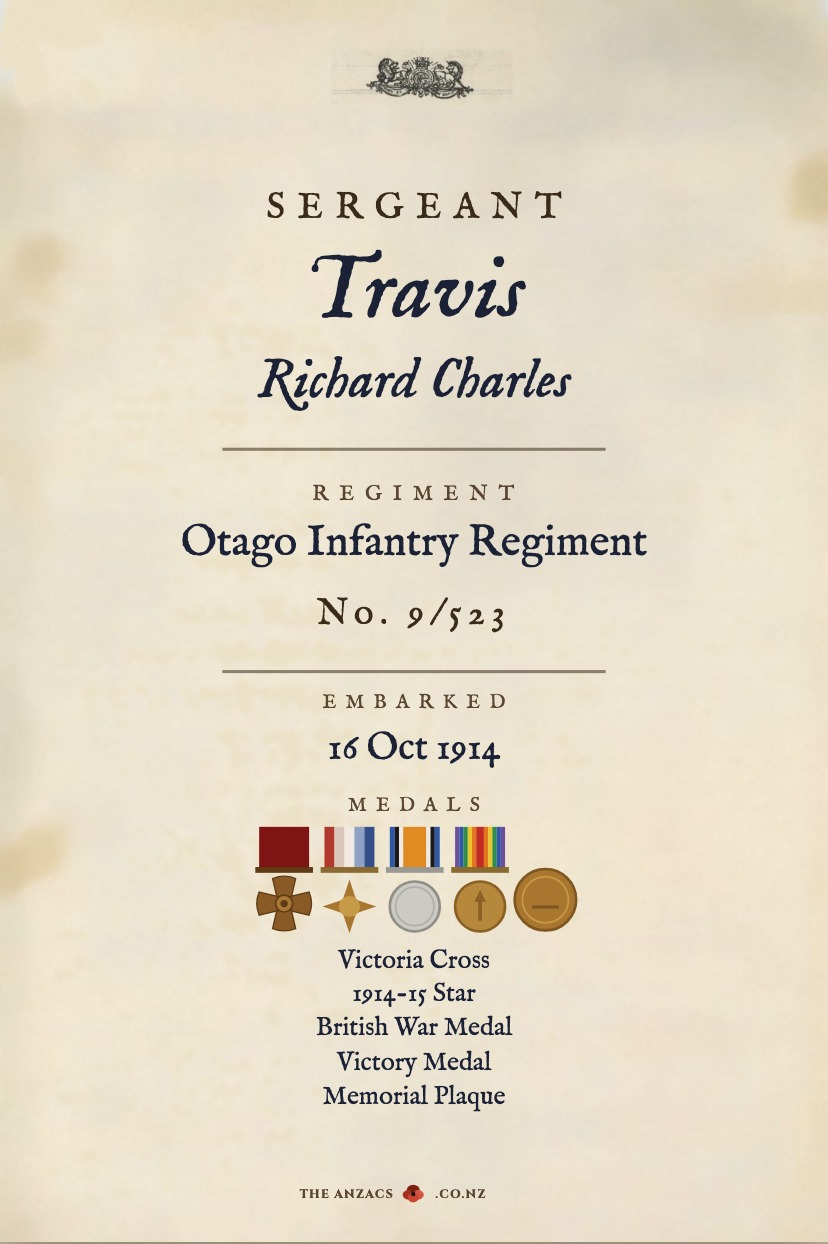
Sergeant Richard Travis VC
He was born Dickson Cornelius Savage, and left that name and his family behind after a falling-out in his twenties, remaking himself in Southland as Richard Charles Travis. By the time he reached Rossignol Wood in 1918 he was already one of the most decorated and feared soldiers on the New Zealand front — the “King of No Man’s Land,” leader of a hand-picked scouting section known simply as Travis’s Gang.
He cleared enemy wire alone in daylight, then killed four Germans single-handed when they tried to retake the guns he’d just captured. He was killed by a shell the next morning, checking on his men.
His story
-
Ōpōtiki
Dickson Cornelius Savage was born on 6 April 1884 at Ōpōtiki, the son of James Savage, an Irish migrant and former member of the Armed Constabulary who farmed at Otara, and Frances Theresa Savage. He left school early to work the family farm, and became a capable shepherd, drover and horse-breaker.
Source: Te Ara Dictionary of New Zealand Biography. -
A new name
After a falling-out with his father, he left home in his early twenties for the Gisborne district, working as a farmhand and building a reputation as a horse-breaker. Following further trouble there, he cut off contact with his family entirely and adopted a new name — Richard Charles Travis — to make a clean break from his old life.
Source: Te Ara Dictionary of New Zealand Biography. -
Ryal Bush, Southland
He arrived in Winton, Southland, in 1910 and found steady work on farms and threshing mills, eventually settling as a farmhand for Tom Murray at Ryal Bush, where he continued breaking horses and became engaged to Murray’s daughter, Lettie. They never married.
Source: Te Ara Dictionary of New Zealand Biography. -
Enlisted
He enlisted in Invercargill with the 7th (Southland) Squadron, Otago Mounted Rifles, giving his occupation as horsebreaker and his fiancée Lettie as next of kin.
Source: Te Ara Dictionary of New Zealand Biography. -
Gallipoli — by stowing away
Left behind in Egypt breaking in horses when his squadron sailed for Gallipoli, he stowed away to join them anyway, was discovered and sent back with fourteen days’ detention, then rejoined his unit on Lemnos in October 1915 and served through to the December evacuation — already earning a reputation for moving through no man’s land unscathed.
Source: Wikipedia; Te Ara Dictionary of New Zealand Biography. -
The Western Front, and Travis’s Gang
He transferred to the infantry after a horse-breaking injury and reached France in April 1916, joining the 8th (Southland) Company, Otago Infantry Regiment, where he began nightly scouting patrols mapping German defences. Twice commended in brigade orders for patrol work and rescuing wounded men, he was himself wounded in mid-1916, and by year’s end — now a sergeant — was given command of his battalion’s sniping and observation section, a hand-picked band that became known across the division as “Travis’s Gang.”
Source: Official History of the Otago Regiment, A.E. Byrne, 1921. -
Already one of the most decorated men in the division
He was awarded the Distinguished Conduct Medal in 1916 for hunting down enemy snipers alone, the Belgian Croix de Guerre in early 1918, and the Military Medal that May for leading a four-man patrol in broad daylight to capture a German machine-gun post and seven prisoners. Fellow soldiers said his judgement of what the enemy would do “sometimes seemed more than human.” He was known for ignoring dress regulations — a balaclava instead of a helmet, two revolvers worn cowboy-fashion — and commanders let it pass because of what he delivered.
Source: Official History of the Otago Regiment; Wikipedia. -
Rossignol Wood
Ahead of an attack near Rossignol Wood, north of Hébuterne, an impassable German wire block needed clearing. In broad daylight and close to enemy posts, Travis crawled out alone and destroyed it with bombs, opening the way for the attacking parties. When the advance was then held up by two machine-gun positions, he rushed them alone, killed the crews and captured both guns. A German officer and three men immediately counter-attacked to retake them — Travis killed all four single-handed, letting the bombing party press on. His own after-action report ended: “Had our party had enough bombs they could have gone to Berlin.”
Source: Official History of the Otago Regiment, quoting his report. -
Killed the next morning
A heavy German bombardment opened around 8am ahead of an expected counter-attack. While going from post to post checking on his men, a shell burst in the trench bay he was in, killing him instantly. The battalion’s own record for that day reads: “His name will live in the records of the Battalion as a glorious example of heroism and devotion to duty.” The official regimental history calls his loss one that “could [not] have stirred men to such deep sorrow.” He was buried the next day at Couin, in falling rain, with the Divisional Commander among the mourners and English troops nearby turning out to applaud the Otago men as they returned from the funeral.
Source: Official History of the Otago Regiment. -
The Victoria Cross, posthumous
The citation: “Serjt. Travis with great gallantry and utter disregard of danger, rushed the position, killed the crews and captured the guns. An enemy officer and three men immediately rushed at him from a bend in the trench and attempted to retake the guns. These four he killed single handed… He was killed 24 hours later when, in a most intense bombardment prior to an enemy counter-attack, he was going from post to post encouraging the men.” — London Gazette, No. 30922
Afterwards
He is buried at Couin New British Cemetery, France. Known to his fellow soldiers as the King of No Man’s Land and the Prince of Scouts, he is remembered today at Ryal Bush, Southland, where a memorial names him as the district’s adopted son and is still the centre of the local Anzac Day service; on a plaque in Queens Gardens, Dunedin; in Travis Barracks at Linton Military Camp and Travis Street in Napier; and in the annual Dick Travis VC Memorial Shoot held by the Karori Rifle Club, Wellington. His medals are held by the Southland Museum and Art Gallery, Invercargill, given by Lettie Murray in 1974.
His sign
Travis is one of the eleven soldiers in The VC Gallery, our stock series honouring New Zealand’s First World War Victoria Cross recipients, on the same corflute sign we make every soldier’s record on.
Photograph
We haven’t hosted a photograph here
A posthumous 1920 portrait of him by Richard Wallwork exists in public collections. Rather than copy someone else’s image onto our own site, we’d rather send you to see it where it’s properly held: his full record at the Auckland War Memorial Museum’s Online Cenotaph, and his story at the Commonwealth War Graves Commission.
Sources
- Richard Charles Travis, Online Cenotaph, Auckland War Memorial Museum.
- Travis, Richard Charles, Te Ara — the Dictionary of New Zealand Biography.
- Richard Travis, Wikipedia.
- Official History of the Otago Regiment, N.Z.E.F., 1914–1918, A. E. Byrne (1921), Chapter XVI.
- Serjeant Dickson Cornelius Savage VC, Commonwealth War Graves Commission.
- 100 Kiwi Stories: the Kiwi king of no man’s land, New Zealand Herald.
Sources disagree on the exact number of siblings he had, and on the precise reasons behind his break with his family. We have kept those parts of the story general rather than state a specific figure either source could not confirm.