Canterbury Mounted Rifles · Main Body · 1914–1919
Trooper Eric Herbert Meadowcroft
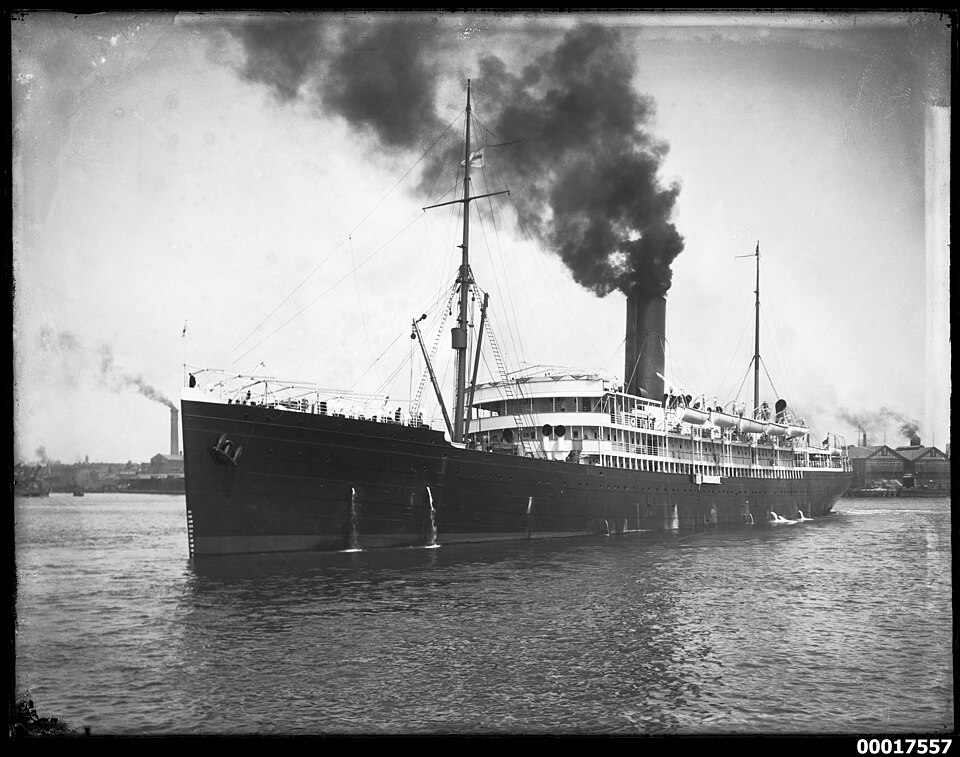
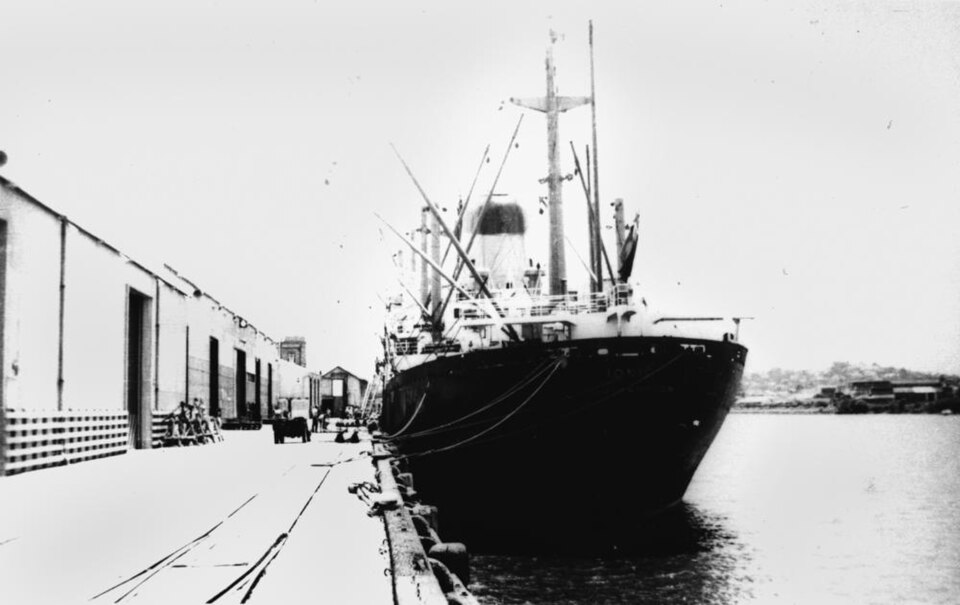
He sailed for the war on the Tahiti in October 1914, and came home on the Ionic in April 1919, after four and a half years away. By then he was a corporal.
Eric was the great-grandfather of Guy Hollister, who made this site. His sign is the first one you see, and this is his story, as far as the records and his family can tell it.
How his medals were found
As told by Guy Hollister, Eric’s great-grandson · around 2004
This was around 2004: about 90 years after Eric sailed for the war in 1914, and about 85 years after he came home in 1919.
My nana had given Eric’s medals to the Henderson RSA, because she didn’t want them. When I found out, I rang the RSA to ask for them back. They told me I had a big job ahead of me, and that it was going to take a while.
They had a huge room full of totes, twenty-litre and thirty-litre totes, holding tens of thousands of medals. They belonged to men who had served and never collected them, or returned them, or whose families hadn’t wanted them. The totes were stacked in hundreds and hundreds of boxes. Each was labelled, but only with long, random and incomplete lists of names, and nobody had been through them with any certainty. There was pretty much no chance of finding one man’s medals quickly. It would take months. I was in for a long run.
So one day I drove to the Henderson RSA. I walked in and identified myself, and a woman took me into the giant room. It was full of totes. She told me again that they were labelled, but not reliably, and that it was going to be an enormous job.
I took a look around the room, and walked forward. I bent down, picked a tote, and took the lid off. I reached in and picked up a couple of bags of medals. The first one I looked at belonged to somebody else. The second one I looked at was my great-grandfather’s: Eric Herbert Meadowcroft.
I turned around. She was still standing there. I just said to her, “That was easy.”
She couldn’t believe what she had just seen. She estimated there were 25,000 medals in that room, and the second pack I opened was Eric’s.
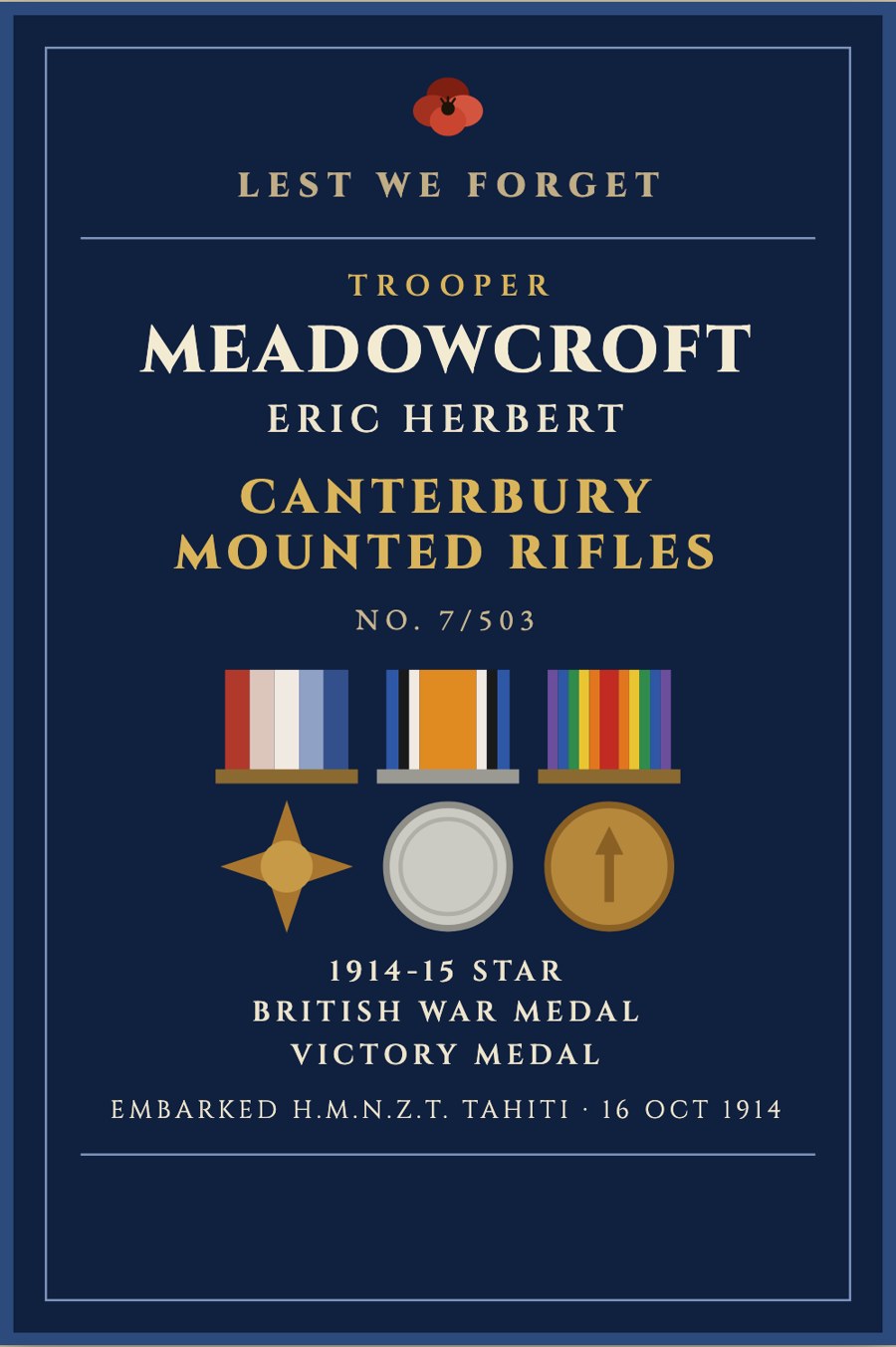
The three medals in that pack are the ones on his sign: the 1914–15 Star, the British War Medal and the Victory Medal.
His story
-
His life before the army
His attestation gives his age at enlistment as 22 years and 4 months, so he was born in about April 1892. He worked as a railway porter, and lived in Sydenham, Christchurch.
Source: his attestation, Archives New Zealand. We are checking the occupation against the record. -
Enlisted
When war broke out, Eric was twenty-two and single. He was attested in Christchurch in August 1914, and his service card counts his army time from 25 August. He went into the Canterbury Mounted Rifles, and was one of the men of the Main Body, the first New Zealanders to sail.
Source: attestation and Nominal Roll, Online Cenotaph and Archives New Zealand. -
Sailing on the Tahiti
The Canterbury Mounted Rifles left Lyttelton on 23 September and embarked on the transports Tahiti and Athenic. Eric’s official date of embarkation is 16 October 1914. The Online Cenotaph lists his ship as “Tahiti or Athenic” because the roll does not say which; his family knows it was the Tahiti.
The New Zealand convoy sailed from Wellington on 14 October, stopped briefly at Hobart, and gathered at Albany, Western Australia, on 28 October to join the Australian troopships. The combined convoy left on 1 November and reached Colombo on 15 November, then went up the Red Sea and through the Suez Canal.
Source: Online Cenotaph; regimental history. The convoy details are for the regiment, not for Eric alone. -
Egypt
The regiment landed at Alexandria on 4 December and moved to a camp at Zeitoun, on the edge of Cairo. Through the winter and spring the men trained in the desert by day and by night, with guard duty and the care of the horses filling the gaps.
Regimental history. -
Gallipoli
The Mounted Rifles went to Gallipoli without their horses. The Canterbury regiment landed at Anzac Cove on 12 May 1915 and took over trenches on the left flank of the beachhead, near Walker’s Ridge. It held them through the Turkish attack of 18–19 May and the long summer that followed, and fought at Chunuk Bair and Hill 60 in August.
We do not yet know exactly what Eric did on the peninsula, or when he left it. That is one of the things we would like to find out.
Regimental history. -
In hospital in England
By September 1915 Eric was in England. New Zealand newspapers printed the names of the sick and wounded in hospital. The Dominion of 14 September 1915 lists Trooper Eric Herbert Meadowcroft (7/503) among those admitted to Beaufort War Hospital, Fishponds, Bristol. The Dominion of 25 September 1915 lists him at the First Southern General Hospital, Birmingham.
We do not know whether he was wounded or sick.
Source: Papers Past, Dominion, 14 and 25 September 1915, “Roll of Honour”. -
The later war
By the end of the war he had risen to corporal. His record card shows the rank, and the medals he earned were stamped for him after the war.
The rest of these years are the biggest gap in what we know. The Canterbury Mounted Rifles fought through the Sinai and Palestine campaign, at Romani, Gaza and Beersheba, and up the Jordan Valley. Whether Eric was with them, or held a different post, is still to be found.
Source: Archives New Zealand service and medal cards. -
His next of kin
When he sailed, Eric’s next of kin was Mrs A. F. Brooke, of Colombo Street, Beckenham, Christchurch. By January 1919 his service card names a different next of kin, Mrs N. H. Meadowcroft, in High Wycombe, England. We think the initials are those of his sister.
Source: Online Cenotaph (embarkation); service card, Archives New Zealand (1919). The family’s belief about the 1919 name. -
Home on the Ionic
Eric came home on the troopship Ionic, the White Star liner. His record shows him back in New Zealand service from 24 April 1919, and his overseas service comes to a little over four and a half years.
Source: service card, Archives New Zealand; the family’s account. -
Otorohanga
His medal card gives his address after the war as Otorohanga, in the Waikato. The three medals he earned were the 1914–15 Star, the British War Medal and the Victory Medal. His card is marked “Medals Stamped”.
Source: medal card, Archives New Zealand.
His ships
The signs made for him
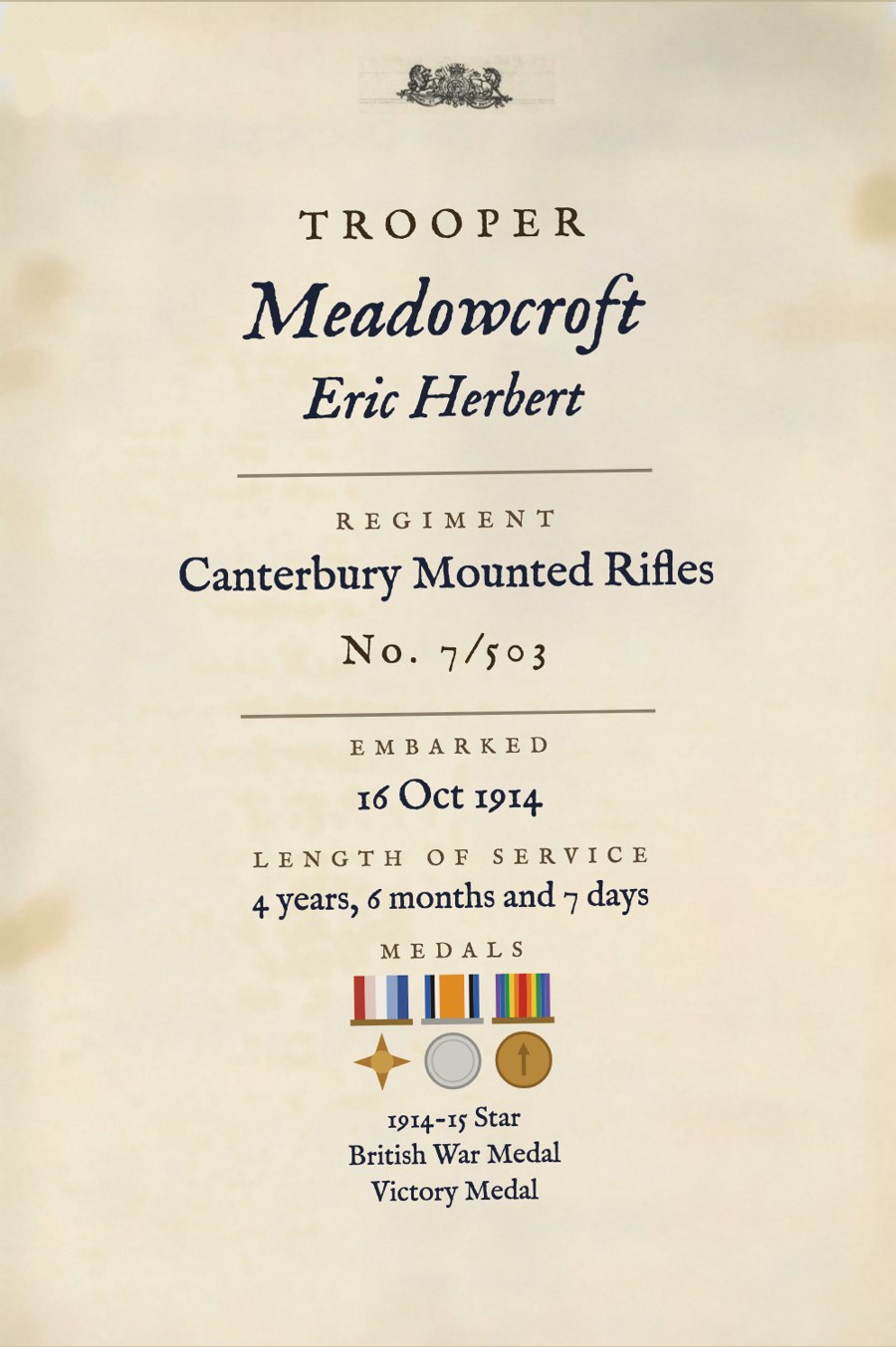
These are the signs this site makes from his record: the Soldier’s Salute, in dark blue, and the Service Record.
Photographs
We have not found a photograph of Eric yet
We searched the online collections and found none. His record cards and papers are held at Archives New Zealand, and his medal card, attestation and service record are the closest we have to his own hand.
If you have a photograph of Trooper Eric Meadowcroft, or know of one, please get in touch through the family, and it will go here.
Sources
- Eric Herbert Meadowcroft, Online Cenotaph, Auckland War Memorial Museum (embarkation, unit, next of kin, and his place in the Nominal Roll).
- Attestation, service record and medal card of 7/503 Eric Herbert Meadowcroft, Archives New Zealand.
- Dominion, 14 September 1915, “Roll of Honour” and 25 September 1915, Papers Past.
- Canterbury Mounted Rifles Regiment, NZ History; and the regiment’s history on Wikipedia.