Sunday, 25 April 1915
Why Anzac Day is 25 April
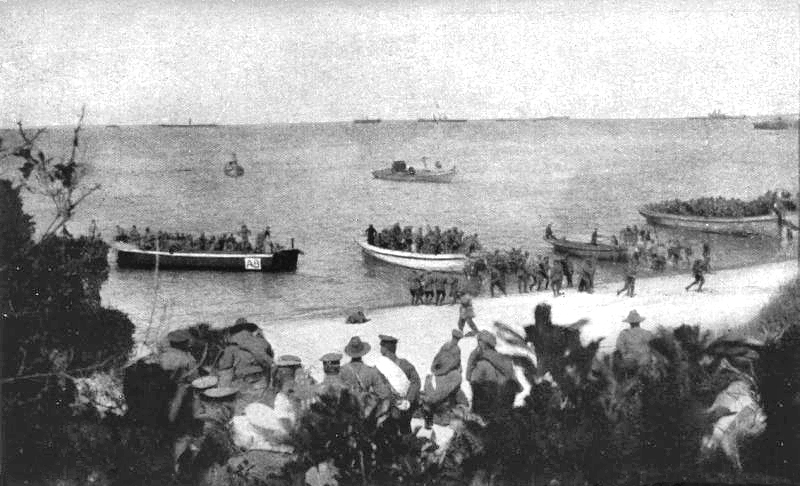
It is the day the Anzacs went ashore at Gallipoli. Before dawn on 25 April 1915, men of the Australian and New Zealand Army Corps climbed into small boats and rowed towards a beach they had never seen. Most of them had never been in a battle. They were planning to assault the beach and then move inland to take more ground. That did not happen. They were pinned down on the beach, and they stayed for eight months.
The day, in numbers
Numbers for a chaotic day are estimates, and sources differ. The 16,000 is from the standard account of the landing; the New Zealand figures are approximate, from New Zealand history sources.
Why the landing matters
The plan was to seize the Gallipoli peninsula and open the way to Constantinople, and knock the Ottoman Empire out of the war. The Anzacs were a small part of a much larger invasion.
The first boats were meant to reach the beach at 3.30 in the morning, an hour before dawn, near Gaba Tepe. The tides and the dark carried them about 1.6 kilometres (a mile) north of the planned beach, to a narrow cove under steep cliffs and gullies. That beach later became known as Anzac Cove. It was less strongly defended than the planned site, but the ground behind it was some of the roughest on the peninsula.
The Ottoman defenders, under officers including Mustafa Kemal, fought hard. The Anzacs got ashore and held a small beachhead, under 3.2 kilometres long and about 700 metres deep at its deepest. They could not go forward, and they could not go back. They stayed for eight months.
New Zealanders at the landing
The New Zealand and Australian Division was formed in Egypt in December 1914, and it landed with the Australians as one force. The New Zealand infantry followed the first Australian waves ashore, and by the end of the day about a fifth of them had been killed or wounded. More than a hundred were dead.
By the end of the campaign, New Zealand had had about 7,500 casualties at Gallipoli, and 2,721 men had been killed. For a country of about a million people, that was very heavy.
Eric Meadowcroft’s regiment, the Canterbury Mounted Rifles, came later. They landed without their horses on 12 May 1915. Read Eric’s story.
How 25 April became Anzac Day
- News of the landing reached New Zealand, and a half-day holiday was declared. Impromptu church and public services were held.
- The first anniversary. Anzac Day was officially named in Australia, and services and marches were held in both countries. Troops on the Western Front also marked it with a dawn parade.
- The Returned Soldiers’ Association lobbied for the day to be a public holiday, and in New Zealand it became one in the early 1920s. It was observed like a Sunday.
- Dawn services begin at about 4.28 in the morning, the time the first Anzac boats began to land. Poppies are worn, and the day is kept in Australia, New Zealand and around the world.
Lest we forget
Anzac Day was born on one beach, on one morning. It has come to stand for every New Zealander who served, in that war and every war since.
Sources
- Landing at Anzac Cove and Anzac Day, Wikipedia (landing numbers, timing, dawn service).
- Anzac Day, Australian Government Anzac Portal, and First Anzac Day, National Museum of Australia.
- Gallipoli landings and Fatalities, NZ History (New Zealand figures).
- Photographs: Australian War Memorial and Wikimedia Commons; each is credited under the picture.