Victoria Cross · Polderhoek, Belgium · 1917
Sergeant Henry Nicholas VC
A Lincoln carpenter who came home from four years working in Australia to join up, and who at Polderhoek in December 1917 left his Lewis gun team, worked alone toward a German strongpoint, shot its commanding officer, and cleared the rest of its garrison with bombs and the bayonet — sixteen men, almost single-handed. He was the first man of the Canterbury Regiment to win the Victoria Cross.
He lived to be invested with it by the King. He did not live to see the war end.
His story
-
Lincoln to Christchurch
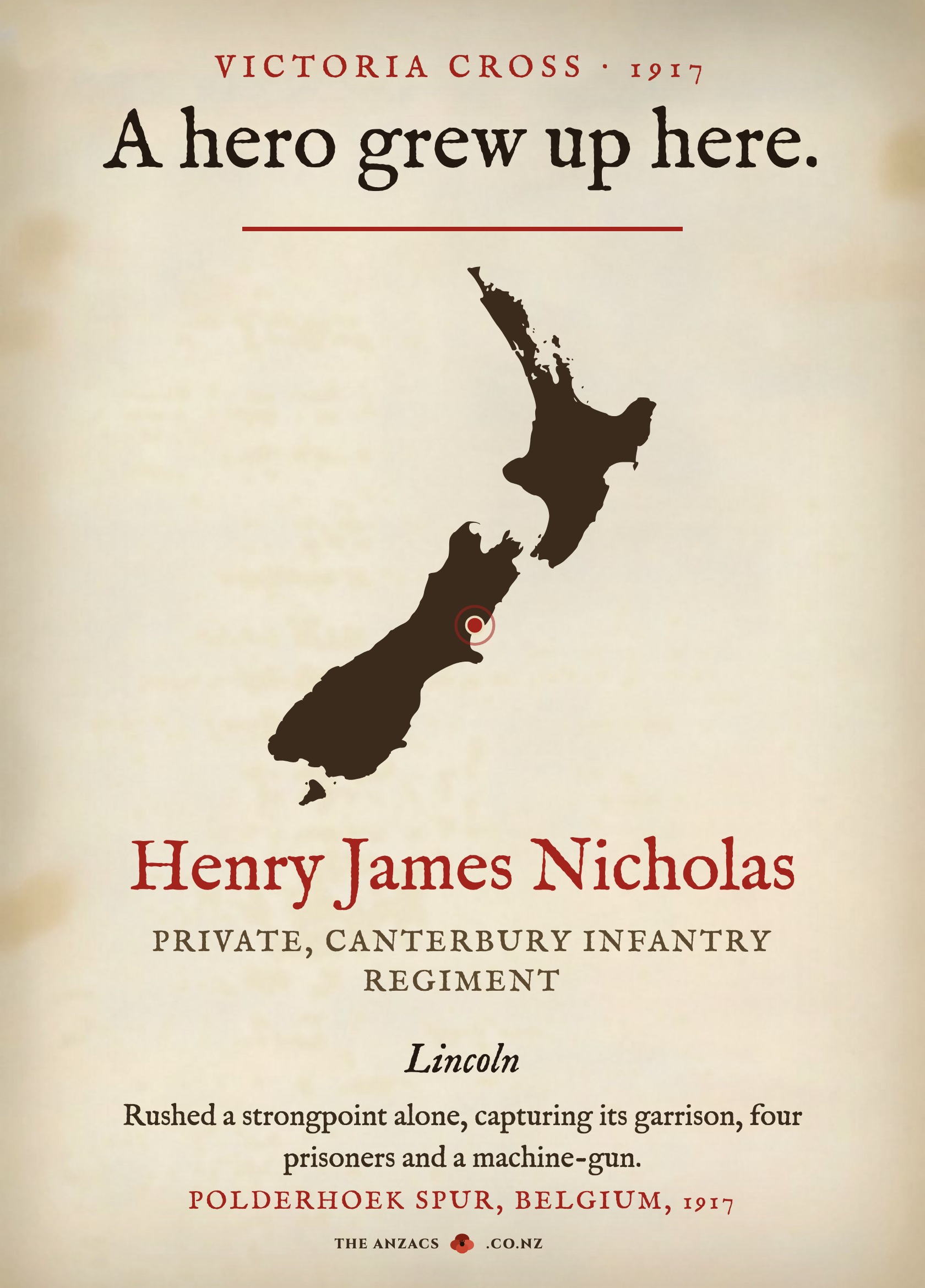
Henry James Nicholas was born on 11 June 1891 at Lincoln, Canterbury, the son of Richard Nicholas, a Cornish-born railway engine driver, and Hannah Nicholas. The family moved to Christchurch, where he went to Christchurch Normal School and Christchurch East School, and trained as a carpenter.
Source: Canterbury Museum; Wikipedia; Christchurch City Libraries. -
Australia
He spent about four years working in Australia before returning to New Zealand in 1915, where he joined the part-time Territorial Force as a Field Engineer. He was a keen amateur boxer, and later became the regimental middleweight champion at Sling Camp in England.
Source: Wikipedia; Canterbury Museum. -
Enlisted
He enlisted at Trentham, occupation given as carpenter, and was posted to the 13th Reinforcements, Canterbury Infantry Battalion.
Source: Wikipedia. -
Sailing for the war
He embarked from Wellington aboard the Willochra or Tofua, joining the 1st Battalion, Canterbury Regiment, 12th (Nelson) Company on the Western Front.
Source: Online Cenotaph; CWGC. -
The Somme, Messines, Passchendaele
He served through the Somme fighting and the Battle of Messines in June 1917. He was sick with mumps in May 1917 and tonsillitis the following year, but was otherwise unwounded as his battalion moved into the Ypres Salient for the Passchendaele offensive.
Source: Canterbury Museum; Wikipedia. -
Polderhoek
In an attack on Polderhoek Spur, Nicholas’s Lewis gun team was checked by heavy machine-gun and rifle fire from a German strongpoint. Followed by the rest of his section at a distance, he rushed forward alone, shot the officer commanding the position, and overcame the rest of its garrison of sixteen with bombs and the bayonet, capturing four wounded prisoners and a machine-gun — taking the strongpoint practically single-handed. When the advance reached its limit, he went on collecting ammunition under continuing machine-gun and rifle fire.
Source: London Gazette, 11 January 1918; Canterbury Museum. -
The Victoria Cross
The citation: “Private Nicholas, who was one of a Lewis gun section… rushed forward alone, shot the officer in command of the strong-point, and overcame the remainder of the garrison of sixteen with bombs and bayonets, capturing four wounded prisoners and a machine-gun. He captured this strong-point practically single-handed, and thereby saved many casualties… His exceptional valour and coolness throughout the operations afforded an inspiring example to all.” — London Gazette
-
Buckingham Palace
Still serving, he was invested with the Victoria Cross by King George V while on leave in England. He deposited the medal for safekeeping with the New Zealand Records Office in London before returning to France that September.
Source: Canterbury Museum. -
The Military Medal
During the final weeks of the war, in fighting on Welsh Ridge and Bon Avis Ridge as the Hindenburg Line was broken near Cambrai, he was awarded the Military Medal for fearless leadership and contempt of danger. It was announced on 14 October — nine days before he was killed.
Source: Canterbury Museum; Wikipedia. -
Beaudignies
By now a sergeant, his battalion had secured the town of Beaudignies near Le Quesnoy, and Nicholas was posted to guard a bridge over the River Ecaillon against German demolition. In darkness, challenging German soldiers he could dimly see approaching, he was shot through the head and killed instantly. Most of the German patrol were killed in the exchange that followed; he was the only New Zealand casualty. He was 27, and the war ended nineteen days later.
Source: Canterbury Museum; Wikipedia; CWGC. -
Presented to his mother
Because his medal was already held safely in London, the physical VC was formally presented to his mother, Hannah Nicholas, at the family home in St Albans, Christchurch, on Anzac Day 1919.
Source: Canterbury Museum, citing the Sun, Christchurch, 26 April 1919.
Afterwards
He was buried with full military honours in Vertigneul Churchyard, Romeries, France, in a service arranged by his battalion chaplain and conducted by the Bishop of Nelson. His mother later bequeathed his VC, Military Medal and service medals to Canterbury Museum, where they remain on permanent display. A bronze statue of him, cast from just three surviving photographs, stands in the Remembrance Gardens on the banks of the Avon in Christchurch, its base built with stone gifted from the town of Le Quesnoy.
His sign
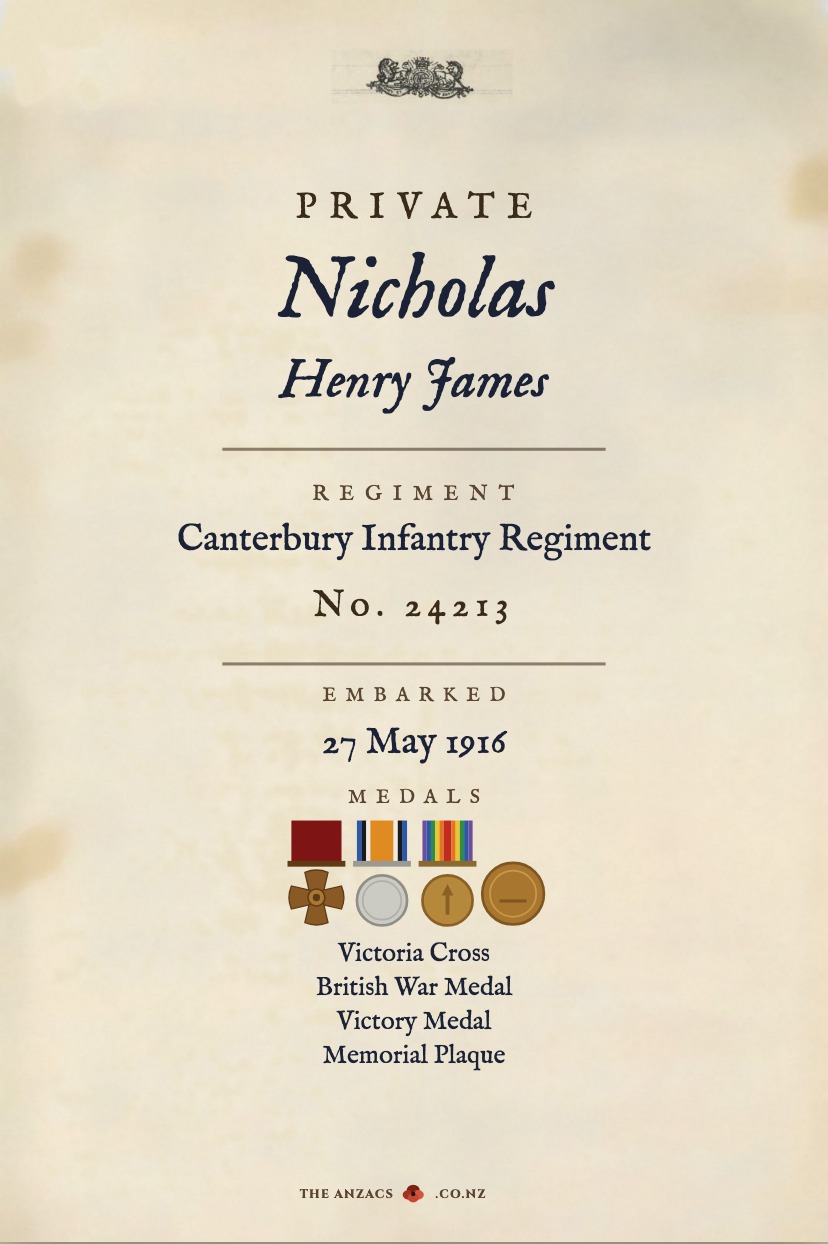
Nicholas is one of the eleven soldiers in The VC Gallery, our stock series honouring New Zealand’s First World War Victoria Cross recipients, on the same corflute sign we make every soldier’s record on.
Photograph
We haven’t hosted a photograph here
Only three photographs of him are known to survive. Rather than copy someone else’s image onto our own site, we’d rather send you to see it where it’s properly held: his full record at the Auckland War Memorial Museum’s Online Cenotaph, and his story at Canterbury Museum, which holds his medals.
Sources
- Henry James Nicholas, Online Cenotaph, Auckland War Memorial Museum.
- Canterbury’s War Hero, Canterbury Museum.
- Henry James Nicholas, Wikipedia.
- Sgt Henry James Nicholas VC MM, Christchurch City Libraries.
- Henry James Nicholas, casualty record, Commonwealth War Graves Commission.
- New Zealand Victoria Cross recipients, NZHistory.
One detail — whether he was briefly promoted corporal on the day of his VC action — appears in only one source. We have left it out pending confirmation.