Victoria Cross · Gouzeaucourt Wood, France · 1918
Sergeant Harry Laurent VC
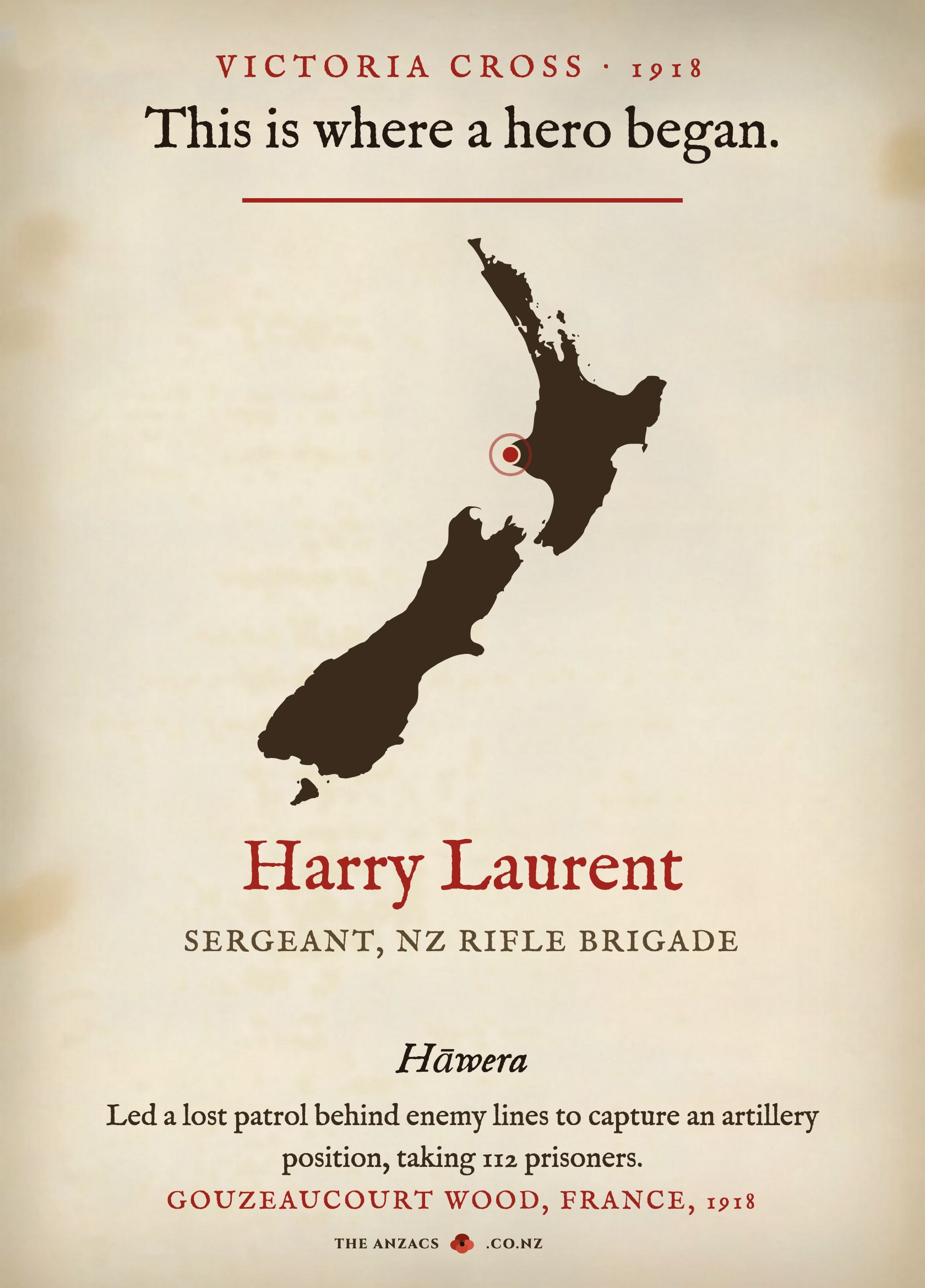
A Hāwera man sent forward with twelve others to find the German front line — who instead found himself deep behind it, facing a strongly held position his patrol was never meant to meet. Rather than slip away, he charged. Thirty Germans were killed and 112 taken prisoner, for four casualties of his own, and then he had to get his tiny patrol and all those prisoners back to New Zealand lines through German counter-attacks.
He outlived every other New Zealand Victoria Cross recipient of the First World War, dying in 1987 at the age of ninety-two.
His story
-
Tarata to Hāwera
Harry John Laurent was born on 15 April 1895 at Tarata, inland Taranaki; the family later moved to Hāwera, where he went to Hāwera District High School. Accounts differ on his trade before the war — a cheese factory, a grocer’s, and engineering work at Tokaora have all been recorded — but he was a young working man in the district when he enlisted in May 1915, shortly after his twentieth birthday.
Source: Wikipedia; Hawke’s Bay Knowledge Bank; National Army Museum. -
Sailing on the Tahiti
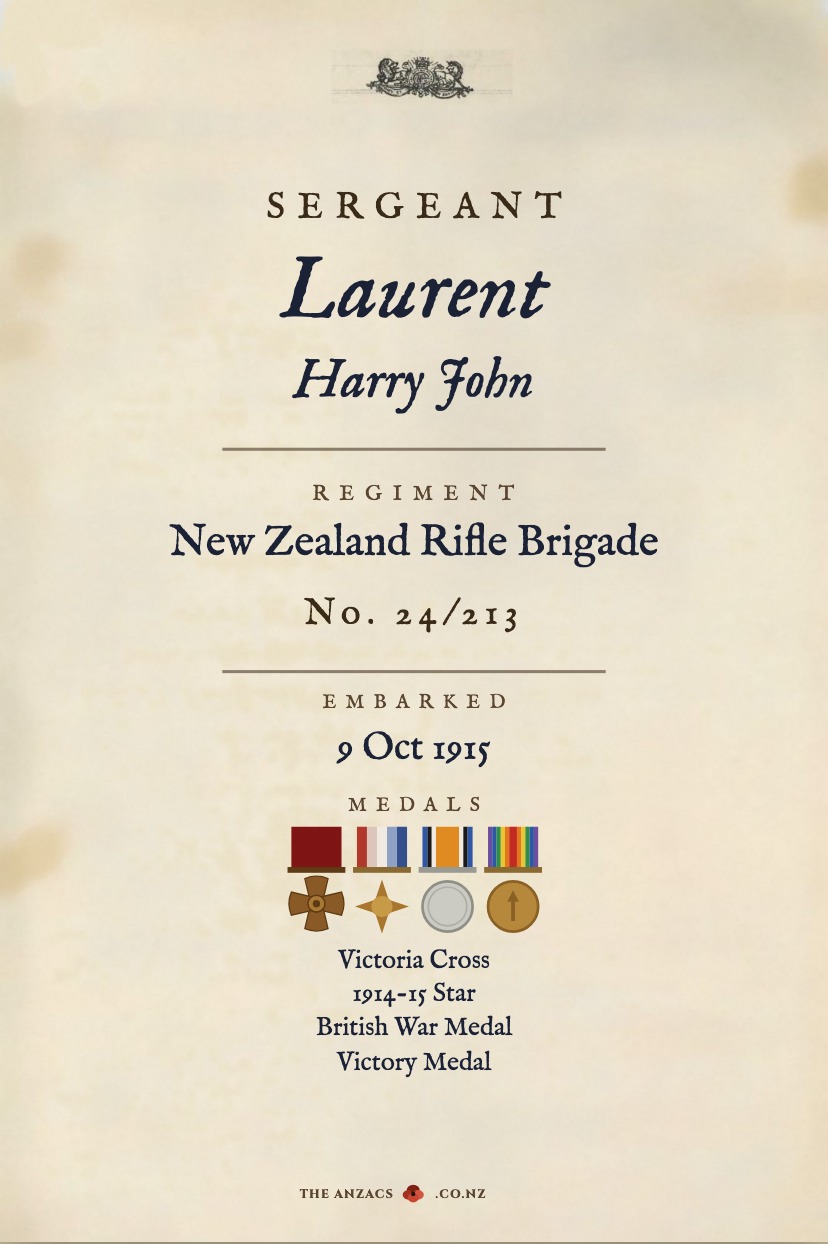
He embarked as a rifleman, A Company, 2nd Battalion, New Zealand Rifle Brigade, aboard HMNZT 31 Tahiti, and served in the Suez Canal defences in Egypt before his unit moved to the Western Front in 1916.
Source: Online Cenotaph; Wikipedia. -
The Somme and after
He was wounded on the Somme in 1916, and went on to serve through the fighting at Messines and Passchendaele in 1917 and the German Spring Offensive of 1918. By September 1918 he had been promoted sergeant.
Source: Wikipedia. -
Gouzeaucourt Wood
As the New Zealand Division pushed on after the Second Battle of Bapaume, Laurent was ordered to take a twelve-man patrol forward to find and re-establish contact with the German line. The patrol overshot, and instead of the expected forward positions found a strongly held German support line. Rather than withdraw, Laurent immediately attacked. In the hand-to-hand fighting that followed, his men killed around thirty Germans; the rest surrendered — one officer and 111 other ranks, 112 prisoners in all, for four casualties in his own patrol. He then had to fight off German counter-attacks while getting his handful of men, and all those prisoners, safely back to New Zealand lines.
Source: London Gazette, Issue 30982; Wikipedia. -
The Victoria Cross
The citation: “With a party of twelve he located the enemy’s support line very strongly held, at once charged the position, followed by his men, and completely disorganised the enemy by his sudden onslaught… thirty of the enemy having been killed, the remainder surrendered, a total of one officer and 111 other ranks in all. The success of this daring venture, which caused his party four casualties only, was due to his gallantry and enterprise.” — London Gazette
-
Home to Hāwera
He returned to a hero’s welcome in Hāwera, where the mayor presented him with a gold watch bought by public subscription, and planted a commemorative oak tree with him at the town’s Water Tower grounds.
Source: Poppy Places, South Taranaki District Council. -
Marriage
He married Ethel Montgomery Homewood in Hāwera; fellow Hāwera VC recipient John Gildroy Grant stood as his best man. They had three sons.
Source: Hawke’s Bay Knowledge Bank; Find a Grave. -
The second war
Recalled to the Reserve of Officers, he commanded Home Guard units in the Hāwera and Taranaki area through the Second World War, reaching temporary Lieutenant-Colonel, and later commanded the local Air Training Corps squadron.
Source: Online Cenotaph; Wikipedia. -
Hastings
He settled in later life at Hastings, in Hawke’s Bay, where he lived into his nineties, rarely speaking of the war unless directly asked.
Source: NZ Herald. -
Hastings
He died in Hastings on 9 December 1987, aged 92 — the last surviving New Zealand recipient of the Victoria Cross from the First World War.
Source: Wikipedia; Find a Grave.
Afterwards
He was cremated and his ashes rest in the memorial wall named for him in the Returned Servicemen’s section of Hāwera Cemetery. His medals are held at the National Army Museum, Waiouru, where they were among nine Victoria Crosses stolen in a notorious 2007 raid and recovered within weeks. In Hāwera he is remembered by Laurent VC Street, laid out alongside Grant VC Street in a pattern representing two V’s and two C’s, and by a statue of him in the Victoria Cross Garden at King Edward Park, unveiled for the centenary of his award in 2018.
His sign
Laurent is one of the eleven soldiers in The VC Gallery, our stock series honouring New Zealand’s First World War Victoria Cross recipients, on the same corflute sign we make every soldier’s record on.
Photograph
We haven’t hosted a photograph here
A 1918 portrait of him is held in the Te Papa collection. Rather than copy someone else’s image onto our own site, we’d rather send you to see it where it’s properly held: his full record at the Auckland War Memorial Museum’s Online Cenotaph, and his portrait at Te Papa.
Sources
- Harry John Laurent, Online Cenotaph, Auckland War Memorial Museum.
- Harry Laurent, Wikipedia.
- Laurent, Harry John, Hawke’s Bay Knowledge Bank.
- Laurent VC Street, Hāwera, Poppy Places.
- London Gazette, Issue 30982, 29 October 1918.
A few details of his working life and his exact retirement date from military service vary between sources we found. If you can help confirm them, we’d welcome it.