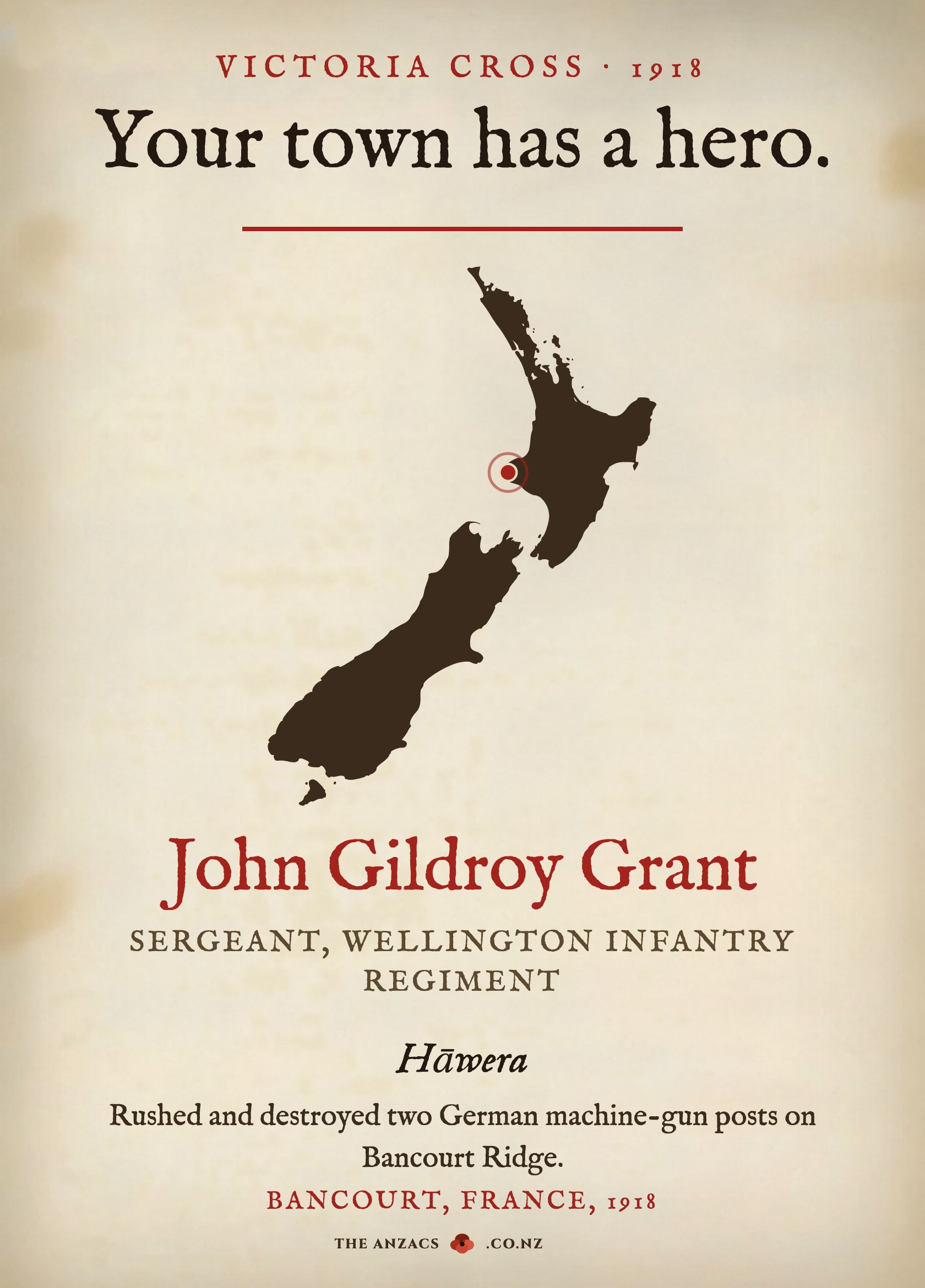
Victoria Cross · Bancourt, France · 1918
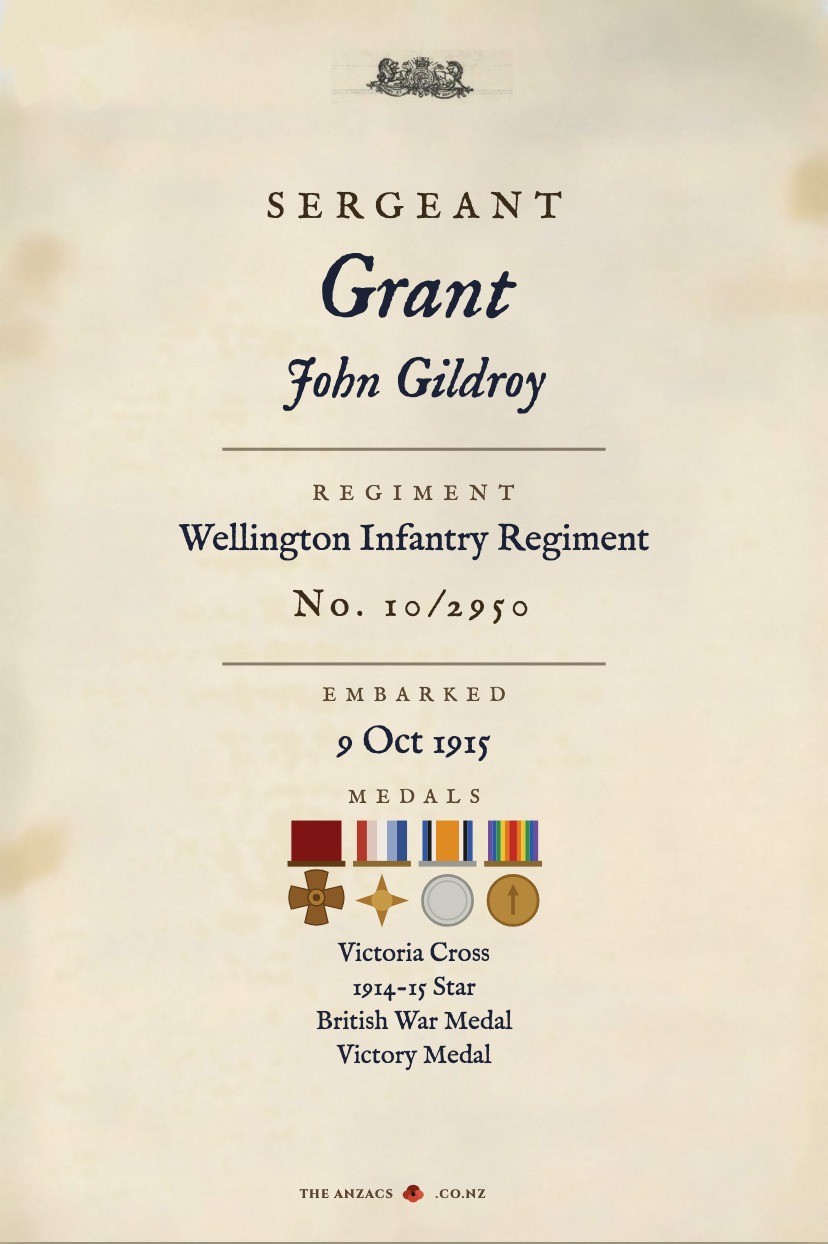
Sergeant John Grant VC
A Hāwera builder and nine-year veteran of the town’s volunteer fire brigade, who at Bancourt in September 1918 broke ahead of his platoon under point-blank fire and rushed a German machine-gun post alone — then did it again at the next one. His citation praised his “coolness, determination, and valour of the highest order.”
He came home to a hero’s welcome, and to a harder life than the citation ever suggested.
His story
-
Hāwera
John Gildroy Grant was born on 26 August 1889 in Hāwera, Taranaki, one of nine children of George and Jane Grant, Scottish migrants. He went to Hāwera Main School, then trained as a carpenter and became a builder and contractor around the district. From 1911 he was also a volunteer fireman with the Hāwera Fire Brigade, rising to First Foreman before he left for the war.
Source: Wikipedia; National Army Museum, “Voices of the Past.” -
Enlisted
He enlisted in the New Zealand Expeditionary Force and joined the Wellington Infantry Regiment.
Source: Online Cenotaph; National Army Museum. -
Sailing on the Aparima
He embarked with the 7th Reinforcements aboard HMNZT 32 Aparima, bound for Egypt, where he joined the 1st Battalion, Wellington Infantry Regiment’s Taranaki Company as the New Zealand Division re-formed after Gallipoli.
Source: Online Cenotaph. -
The Somme, Messines, Broodseinde
His battalion moved to the Western Front in March 1916 and fought through the Somme, then at Messines in June 1917, where it helped encircle and capture the village at a cost of over four hundred casualties. He was promoted corporal in June 1917 and sergeant early in 1918.
Source: Wikipedia. -
Bancourt
Commanding a platoon in the leading waves attacking high ground east of Bancourt, Grant’s company reached the crest to find a line of five German machine-gun posts blocking the advance. Under point-blank fire, and about twenty yards out, Grant broke ahead of his platoon with a comrade, Lance Corporal Cecil Hill close behind, and rushed the centre post, demoralising its garrison and letting his men mop it up. He then rushed the post on the left in the same way; the rest were quickly cleared by the company. His battalion was relieved that evening.
Source: London Gazette, Issue 31034; Wikipedia. -
The Victoria Cross
The citation: “When about twenty yards from the posts Sjt. Grant, closely followed by a comrade, rushed forward ahead of his platoon, and with great dash and bravery entered the centre post, demoralising the garrison and enabling the men of his platoon to mop up the position. In the same manner he then rushed the post on the left… Sjt. Grant displayed coolness, determination, and valour of the highest order, and set a splendid example to all.” — London Gazette
-
Buckingham Palace
King George V presented him with the VC in a joint investiture with fellow New Zealand recipients James Crichton, Reginald Judson and Harry Laurent.
Source: Wikipedia, citing the New Zealand Herald, 8 April 1919. -
Home to Hāwera
He returned to a formal civic welcome in Hāwera and was presented with an inscribed gold watch, bought by public subscription.
Source: Wikipedia, citing the Hawera & Normanby Star, 29 October 1919. -
Council, and a friend’s wedding
He was elected a Hāwera city councillor in 1921, and that August stood as best man when fellow Hāwera VC recipient Harry Laurent married. In 1929 he travelled to London for a formal dinner of Victoria Cross recipients.
Source: Wikipedia. -
Harder years
He later moved to Paeroa but struggled to find steady work. His marriage broke down and he was made bankrupt; in 1934 the authorities investigated his circumstances and attributed his difficulties to his own erratic behaviour. Historians now believe he was very likely suffering from what would today be recognised as post-traumatic stress disorder — undiagnosed and unnamed in his own lifetime.
Source: Wikipedia, citing Harper & Richardson, In the Face of the Enemy; Gliddon, Road to Victory 1918. -
Auckland
By 1968 his health required public donations to cover his flights and medical care to attend a VC reunion. He became a freemason and spent his final years at the Roskill Masonic Village, Mount Roskill, Auckland.
Source: Wikipedia, citing Gliddon.
Afterwards
He died on 25 November 1970 at the Roskill Masonic Village, aged 81, and was buried at Waikumete Cemetery, Auckland. His medals are held between the QEII Army Memorial Museum at Waiouru and Puke Ariki, New Plymouth. He is remembered in Hāwera today by Grant VC Street, laid out alongside Laurent VC Street in a pattern representing two V’s and two C’s, and by a statue of him in the Victoria Cross Garden at King Edward Park, unveiled for the centenary of his award in 2018. His VC was, in NZHistory’s words, the last awarded to a member of the New Zealand Expeditionary Force in the First World War.
His sign
Grant is one of the eleven soldiers in The VC Gallery, our stock series honouring New Zealand’s First World War Victoria Cross recipients, on the same corflute sign we make every soldier’s record on.
Photograph
We haven’t hosted a photograph here
Rather than copy someone else’s image onto our own site, we’d rather send you to see it where it’s properly held: his full record at the Auckland War Memorial Museum’s Online Cenotaph.
Sources
- John Gildroy Grant, Online Cenotaph, Auckland War Memorial Museum.
- John Gildroy Grant, Wikipedia.
- John Grant: A Builder from Hāwera with “Valour of the Highest Order”, National Army Museum.
- John Gildroy Grant, 1918, NZHistory.
- The Victoria Cross Garden, South Taranaki District Council.
His wife’s name and details of his two children could not be confirmed from any source we could access. If you can help, we’d welcome it.