Victoria Cross · Messines, Belgium · 1917
Corporal Samuel Frickleton VC
One of five brothers who mined coal together at Blackball, on the West Coast, after their family emigrated from Scotland. When the New Zealand advance at Messines stalled under German machine-gun fire, Frickleton — already wounded in the arm — led his section forward through the barrage and destroyed two enemy posts with grenade, rifle and bayonet, one of them a crew of twelve.
He came home the first New Zealand VC recipient to do so while the war was still being fought, to a welcome that met him in three different cities.
His story
-
Slamannan
Samuel Frickleton was born on 1 April 1891 at Old Lodge, Slamannan, Stirlingshire, Scotland, one of eleven children of Samuel Frickleton, a coal miner, and Elizabeth Frickleton. By 1911 seven Frickleton sons were working the Scottish mines alongside their father. After his father’s death, Samuel emigrated to New Zealand with his mother and several siblings to join an older brother already in Blackball, on the West Coast, where the family went to work in the coal mine — locally remembered, with their taste for boxing, as the “Fighting Frickletons.”
Source: Wikipedia; Te Ara, West Coast places. -
Enlisted
He enlisted at Greymouth, giving his occupation as coal miner.
Source: victoriacrossonline.co.uk. -
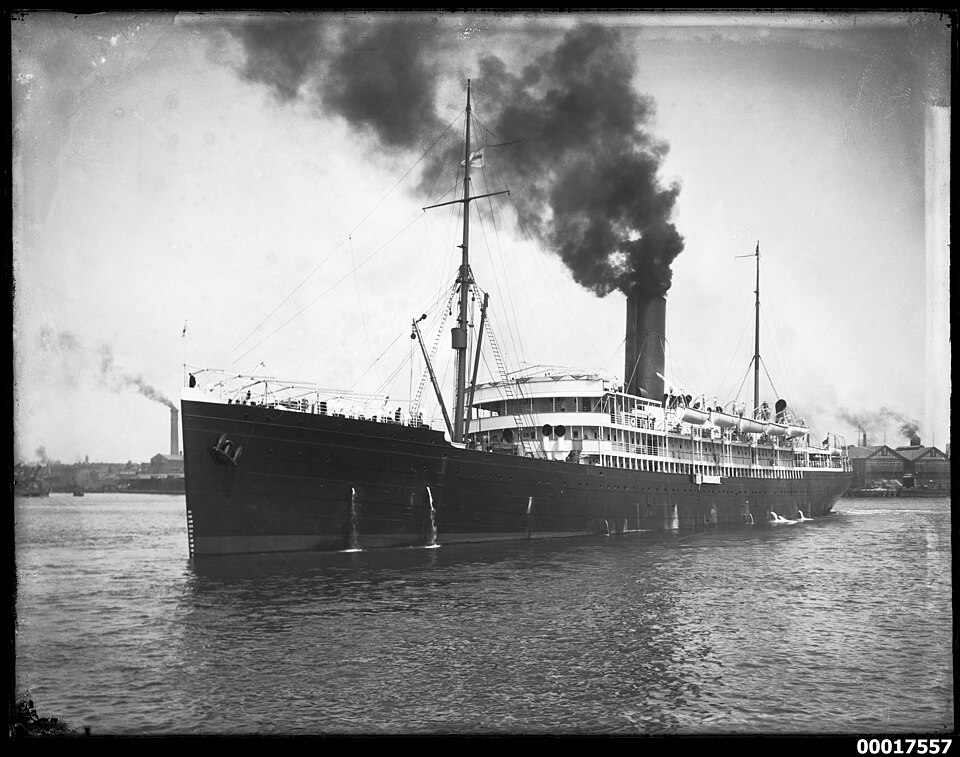
Sailing on the Tahiti
He embarked as a corporal with the 5th Reinforcements, Canterbury Infantry Battalion, aboard HMNZT 25 Tahiti, reaching Egypt that August.
Source: Online Cenotaph. -
Sent home, and back again
He was discharged medically unfit that November and returned to New Zealand — but re-enlisted the following April, embarking again that July and reaching France by November 1916, posted this time to the 3rd Battalion, New Zealand Rifle Brigade.
Source: victoriacrossonline.co.uk; Wikipedia. -
Messines
At 3:10am, the Battle of Messines opened with a series of massive mine explosions under the German lines. As the New Zealand advance crossed the ridge, it stalled under intense machine-gun fire from the reverse slope. Already wounded in the arm, Lance Corporal Frickleton led his section forward through the barrage, threw a grenade into the first German machine-gun post, rushed it and finished the crew with the bayonet, then attacked a second post roughly twenty-five metres on, killing its crew of twelve and destroying the gun. He was wounded a second time, more seriously, during the fighting to hold Messines village afterward.
Source: London Gazette, 2 August 1917; National Army Museum. -
The Victoria Cross
The citation: “Although slightly wounded, Cpl. Frickleton dashed forward at the head of his section, pushed into the barrage, and personally destroyed with bombs an enemy machine gun and crew which was causing heavy casualties. He then attacked a second gun, killing the whole of the crew of twelve… his magnificent courage and gallantry ensured the capture of the objective. During the consolidation of the position he received a severe second wound.” — London Gazette
-
Ibrox Park, Glasgow
King George V invested him with the VC in an open-air ceremony at Ibrox Park, Glasgow — the first such public investiture in Scotland since the Union of the Crowns, before a crowd reported to include thousands of munitions workers.
Source: victoriacrossonline.co.uk. -
Home before the war ended
Declared medically unfit again after officer training at Cambridge and a commission as Second Lieutenant, he returned to New Zealand — the first New Zealand VC recipient to come home while the war was still being fought — and was given large civic receptions in Wellington, Christchurch and on the West Coast.
Source: Te Ara, West Coast places; Wikipedia. -
Staff Corps
He continued in the New Zealand Staff Corps, commissioned Lieutenant in 1919, and retired on medical grounds as a Captain in 1927. He married Valeska Gembitzsky in 1922; they settled at Naenae, Wellington, and had a son, Logan.
Source: victoriacrossonline.co.uk. -
The second war
He tried to re-enlist for overseas service in the Second World War but was rejected on medical grounds, and instead served on the home front as Inspector of the New Zealand Military Forces until 1948.
Source: victoriacrossonline.co.uk.
Afterwards
He died on 1 September 1971 at Hutt Hospital, aged 80, and is buried at Taita Servicemen’s Cemetery, Naenae. His widow Valeska gave his medals to the Queen Elizabeth II Army Memorial Museum, Waiouru, in 1977, where they were among nine Victoria Crosses stolen in a notorious 2007 raid and recovered within weeks. He is remembered by Frickleton VC Lines, the barracks named for him at Burnham Military Camp, by a memorial cairn in his birthplace of Slamannan, Scotland, and by a plaque unveiled outside the church at Mesen, Belgium, on the ninetieth anniversary of his VC action.
His ship
His sign
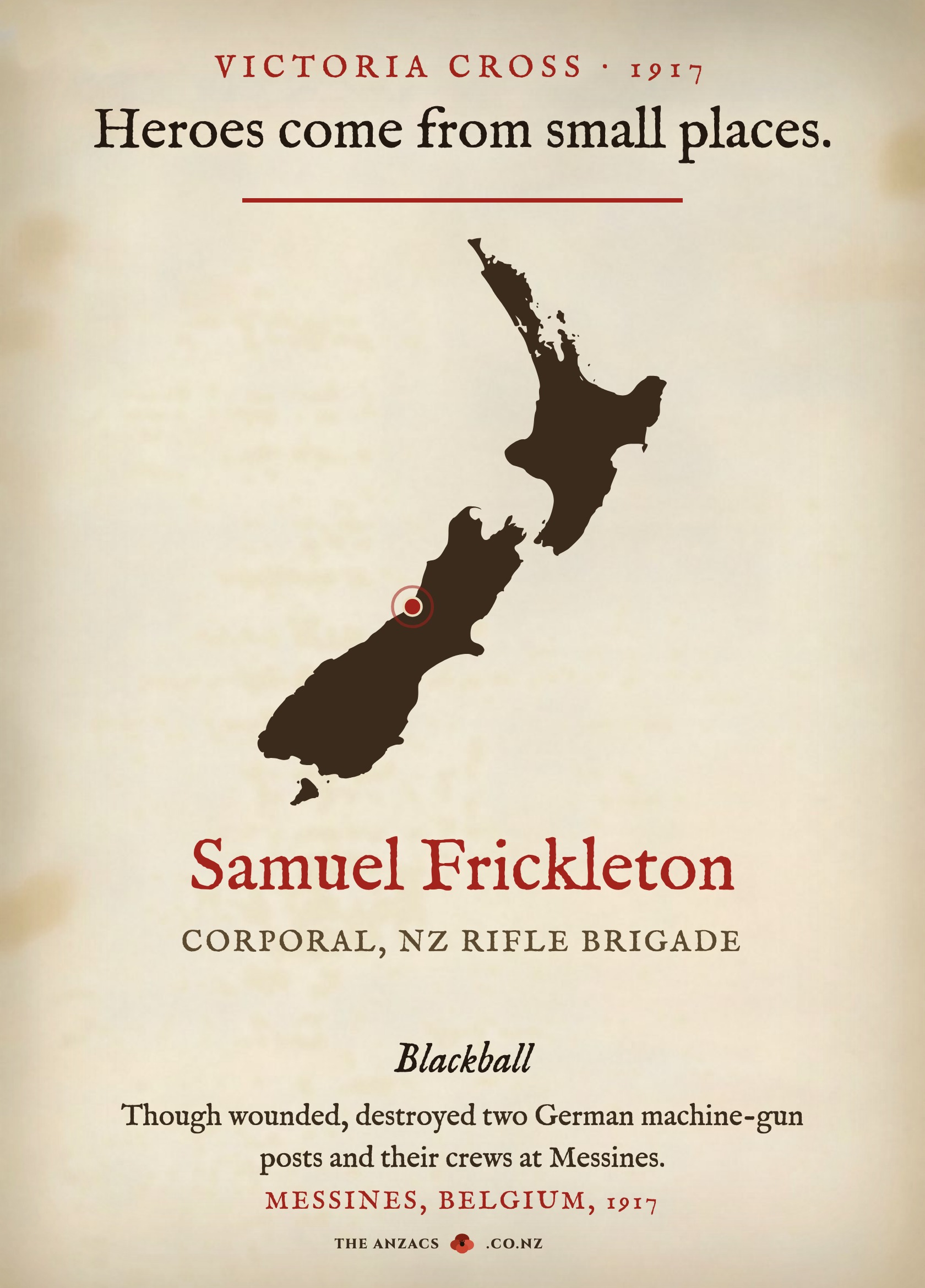
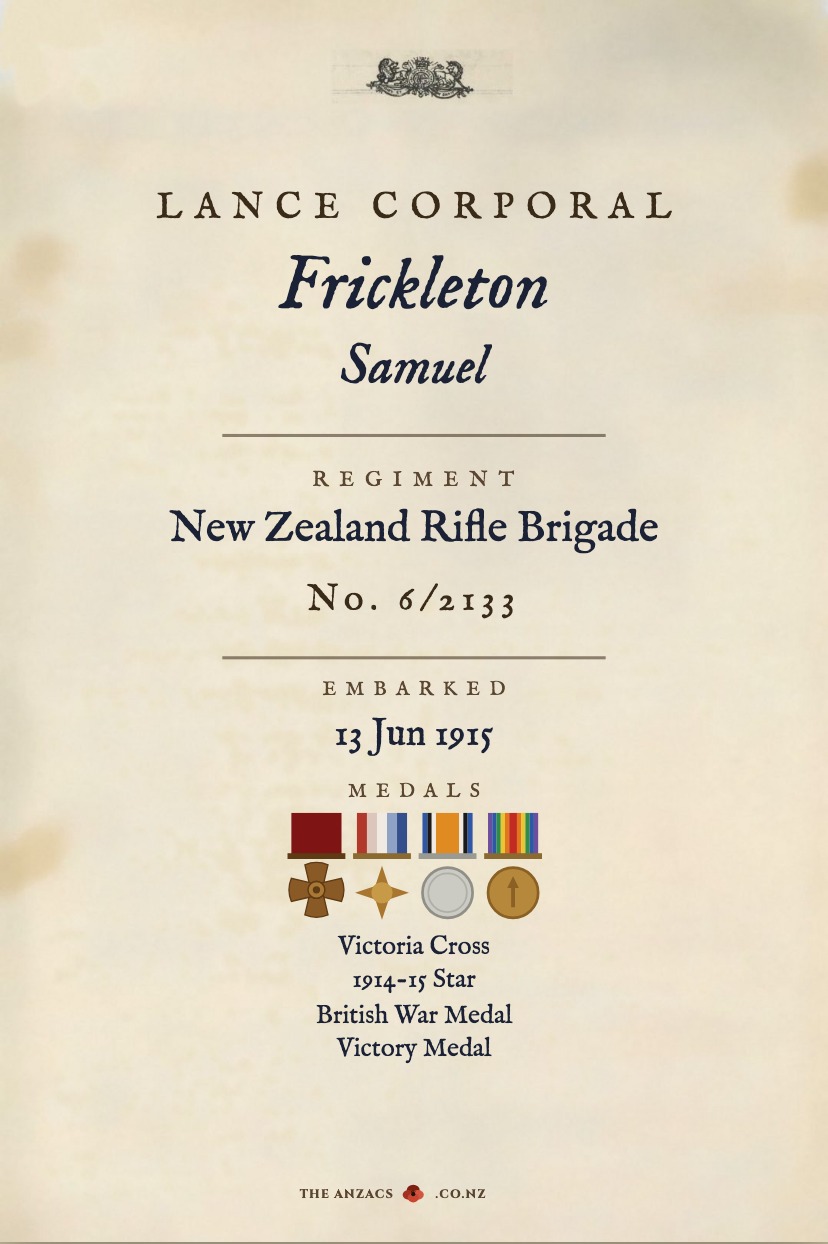
Frickleton is one of the eleven soldiers in The VC Gallery, our stock series honouring New Zealand’s First World War Victoria Cross recipients, on the same corflute sign we make every soldier’s record on.
Photograph
We haven’t hosted a photograph here
Rather than copy someone else’s image onto our own site, we’d rather send you to see it where it’s properly held: his full record at the Auckland War Memorial Museum’s Online Cenotaph.
Sources
- Samuel Frickleton, Online Cenotaph, Auckland War Memorial Museum.
- Samuel Frickleton, Wikipedia.
- West Coast places, Te Ara — the Encyclopedia of New Zealand.
- Samuel Frickleton: Magnificent Courage and Gallantry at Messines, National Army Museum.
- Samuel Frickleton VC, Victoria Cross Online.
The exact year his family emigrated from Scotland, and the precise date of his death, vary slightly between the sources we found — we have used the version most widely agreed on. If you can help confirm them, we’d welcome it.