Victoria Cross · Grévillers, France · 1918
Sergeant Samuel Forsyth VC
A Wellington engineer who sailed with the very first contingent in 1914 and was still fighting four years later, days away from an officer’s commission he never lived to take up. At Grévillers he cleared three machine-gun posts, was wounded getting help from a tank, and kept going anyway — organising the tank’s crew and his own men into a scratch unit that forced the German guns to fall silent. He was killed by a sniper the moment they did.
His widow received the medal in his place.
His story
-
Wellington
Samuel Forsyth was born on 3 April 1892 in Wellington, one of four children of Thomas Forsyth, a night watchman on the SS Maori at Thorndon, and his wife Grace. He was educated at Thorndon School and Terrace School, and volunteered with the Sailors’ Friend Society in Wellington — likely following his father’s connection to the waterfront. He worked as a gold amalgamator for the Monowai Gold Mining Company at Thames, and from 1910 served as a field engineer in the Territorial Force, which set the course of his war service.
Source: Wikipedia; Lord Ashcroft Medal Collection. -
Enlisted
He enlisted as a sapper in the New Zealand Field Engineers within days of the outbreak of war.
Source: Wikipedia; Online Cenotaph. -
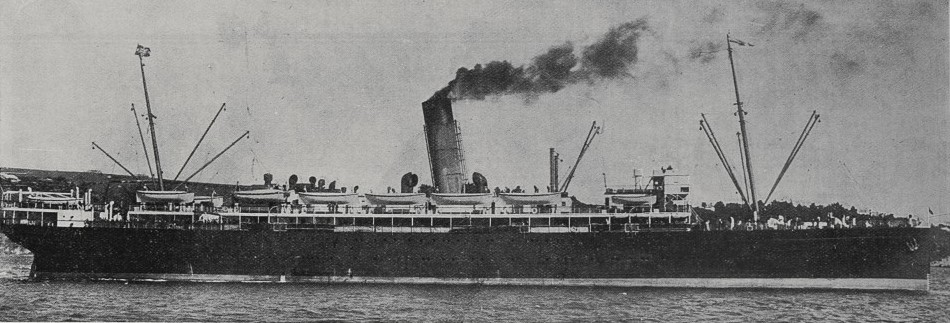
Sailing on the Maunganui
He embarked with the Main Body — the very first New Zealand troops to leave for the war — aboard HMNZT 3 Maunganui, reaching Suez by early December.
Source: Online Cenotaph. -
Gallipoli
He landed at Anzac Cove and worked on engineering and trench tasks at Walker’s Ridge, was hospitalised with influenza in July, lightly wounded during the August offensive, and evacuated with jaundice that November.
Source: Wikipedia; CWGC. -
The Western Front
He rejoined the 3rd Field Company, New Zealand Engineers, and served through Messines and Passchendaele in 1917 and the German Spring Offensive in 1918, rising from sapper to lance corporal, corporal, and sergeant. By August 1918 he had been recommended for a commission, and was attached to the 2nd Battalion, Auckland Infantry Regiment to gain front-line infantry experience before taking it up.
Source: Wikipedia; CWGC. -
Grévillers
Near Grévillers during the Second Battle of Bapaume, his company came under heavy machine-gun fire as it neared its objective. Forsyth’s leadership saw three machine-gun posts rushed and their crews captured before they could inflict serious casualties. As the advance came under fire from further guns, he scouted forward under fire and located two more positions, then went to bring up a tank for support — and was wounded doing it. He had the wound bandaged and went straight back, trying to guide the tank into a firing position under heavy fire until it was knocked out. He then organised the tank’s crew and several of his own men into a flanking party and, still under fire, led them to outflank the machine guns and force the German crews to withdraw. The advance went on. He was killed by a sniper at that moment.
Source: London Gazette, Issue 30967; CWGC. -
The Victoria Cross
His VC was gazetted less than two months after his death.
The citation: “For most conspicuous bravery and devotion to duty in attack… In his endeavour to gain support from a Tank, he was wounded, but after having the wound bandaged, he again got in touch with the Tank… Serjt. Forsyth then organised the Tank crew and several of his men into a section, and led them to a position where the machine guns could be outflanked… He was at that moment killed by a sniper.” — London Gazette
-
Presented to his widow
He had married Mary, from Glasgow, while on leave in 1916. King George V presented the Victoria Cross to her at Buckingham Palace. They had no children; his medals later passed to a nephew.
Source: Wikipedia; Lord Ashcroft Medal Collection.
Afterwards
He is buried at Adanac Military Cemetery in Miraumont, one of seventy New Zealanders resting there. His medal group was sold by his nephew in 1982 and later bought by Lord Ashcroft in 1992; it is now on public display in the Lord Ashcroft Gallery at the Imperial War Museum, London. He is remembered on the Victoria Cross winners’ plaque in Queens Gardens, Dunedin, and a memorial tablet at the Sailors’ Friend Society in Wellington, where he had volunteered before the war.
His ship
His sign
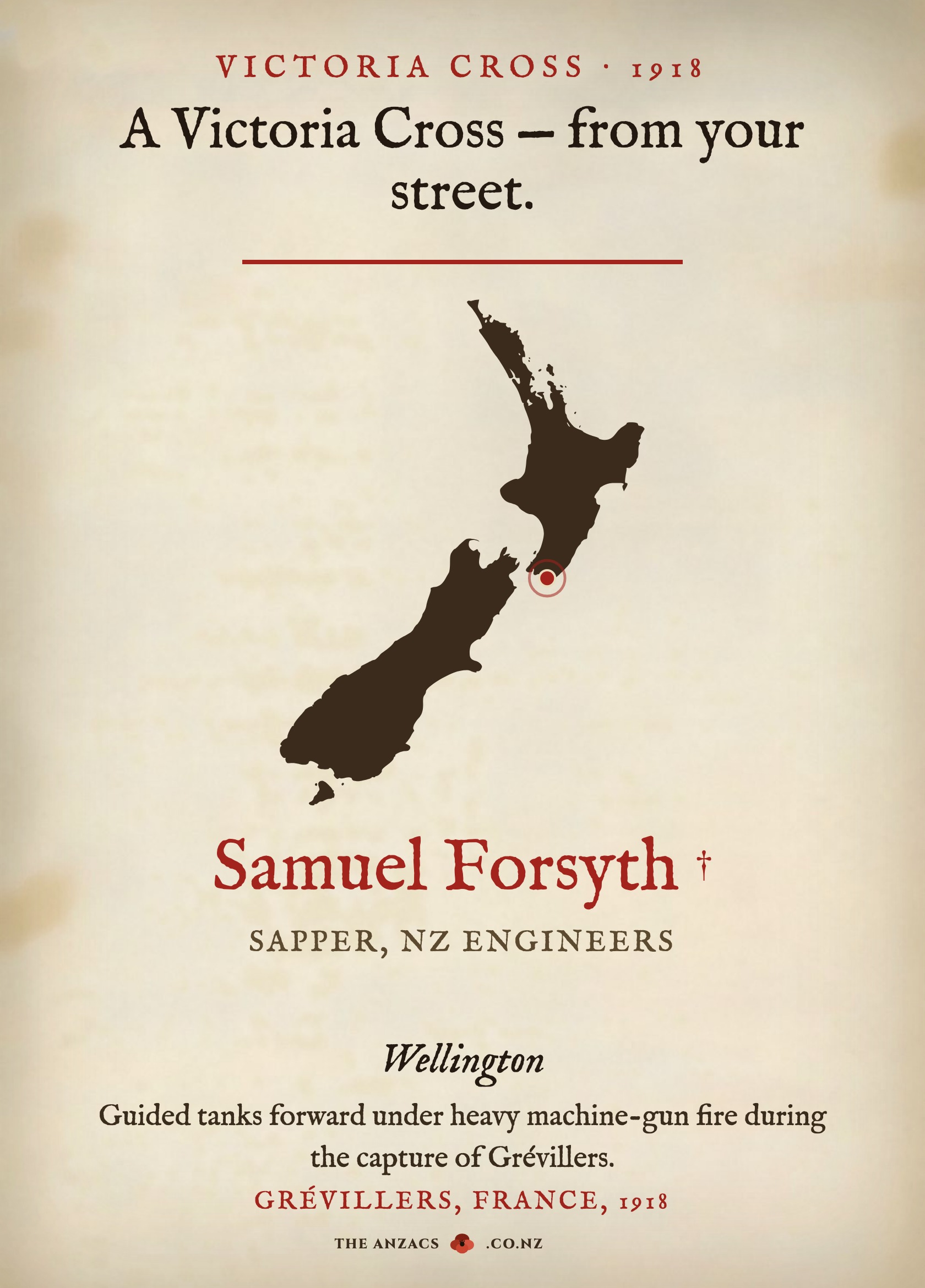
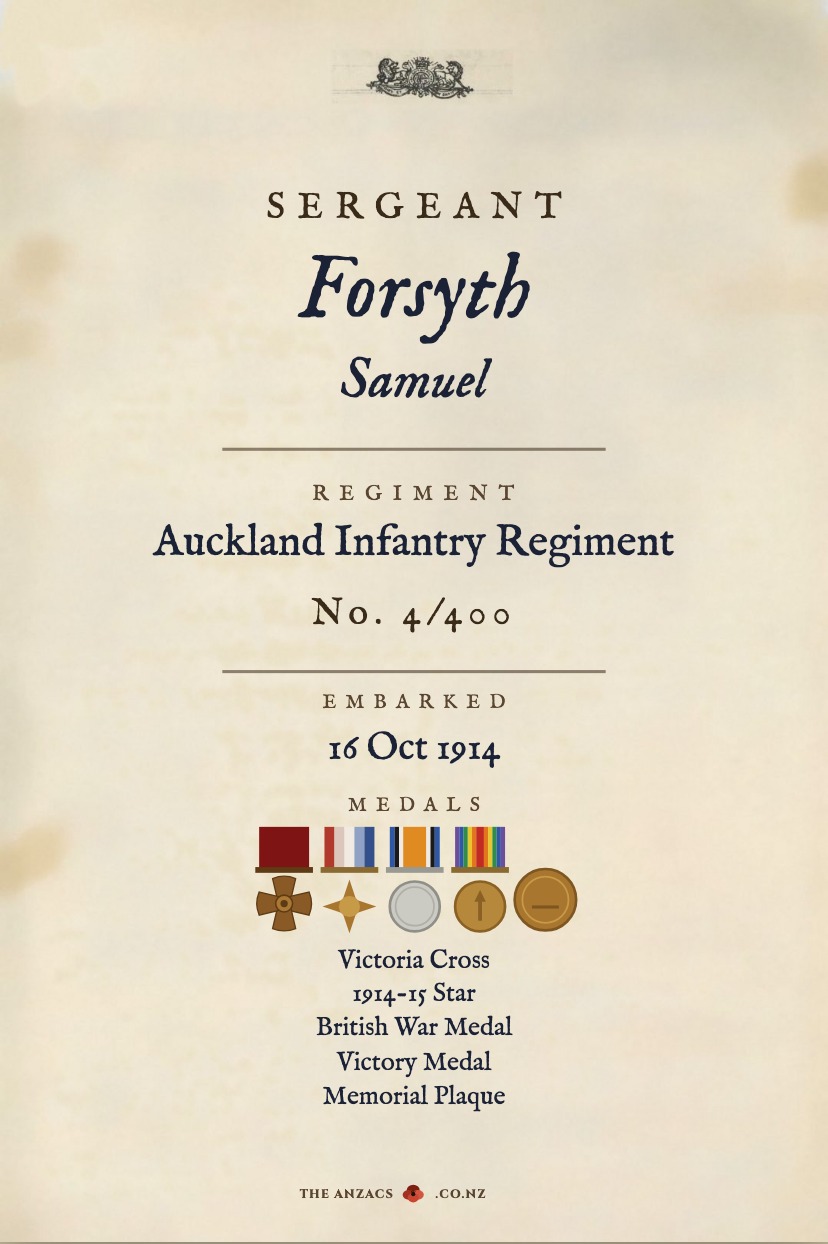
Forsyth is one of the eleven soldiers in The VC Gallery, our stock series honouring New Zealand’s First World War Victoria Cross recipients, on the same corflute sign we make every soldier’s record on.
Photograph
We haven’t hosted a photograph here
Rather than copy someone else’s image onto our own site, we’d rather send you to see it where it’s properly held: his full record at the Auckland War Memorial Museum’s Online Cenotaph, and his story at the Commonwealth War Graves Commission.
Sources
- Samuel Forsyth, Online Cenotaph, Auckland War Memorial Museum.
- Samuel Forsyth, Wikipedia.
- Serjeant Samuel Forsyth VC, and casualty record, Commonwealth War Graves Commission.
- Samuel Forsyth VC, Lord Ashcroft Medal Collection.
- London Gazette, Issue 30967, 18 October 1918.
- Samuel Forsyth, 1918, NZHistory.
A few details of his family life after his marriage in 1916 come from a single newspaper reference we could not fully verify. If you can help confirm them, we’d welcome it.