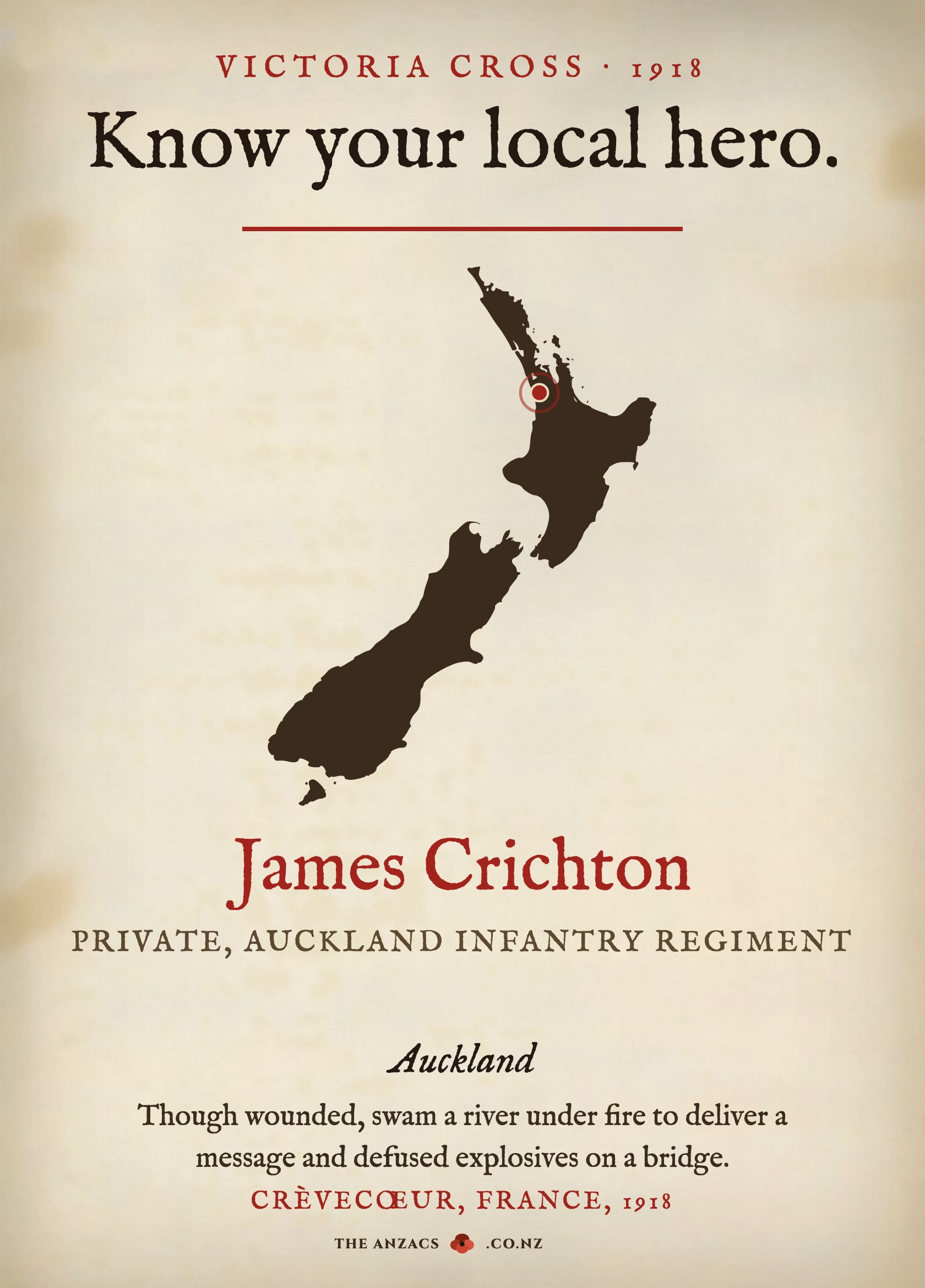
Victoria Cross · Crèvecoeur, France · 1918
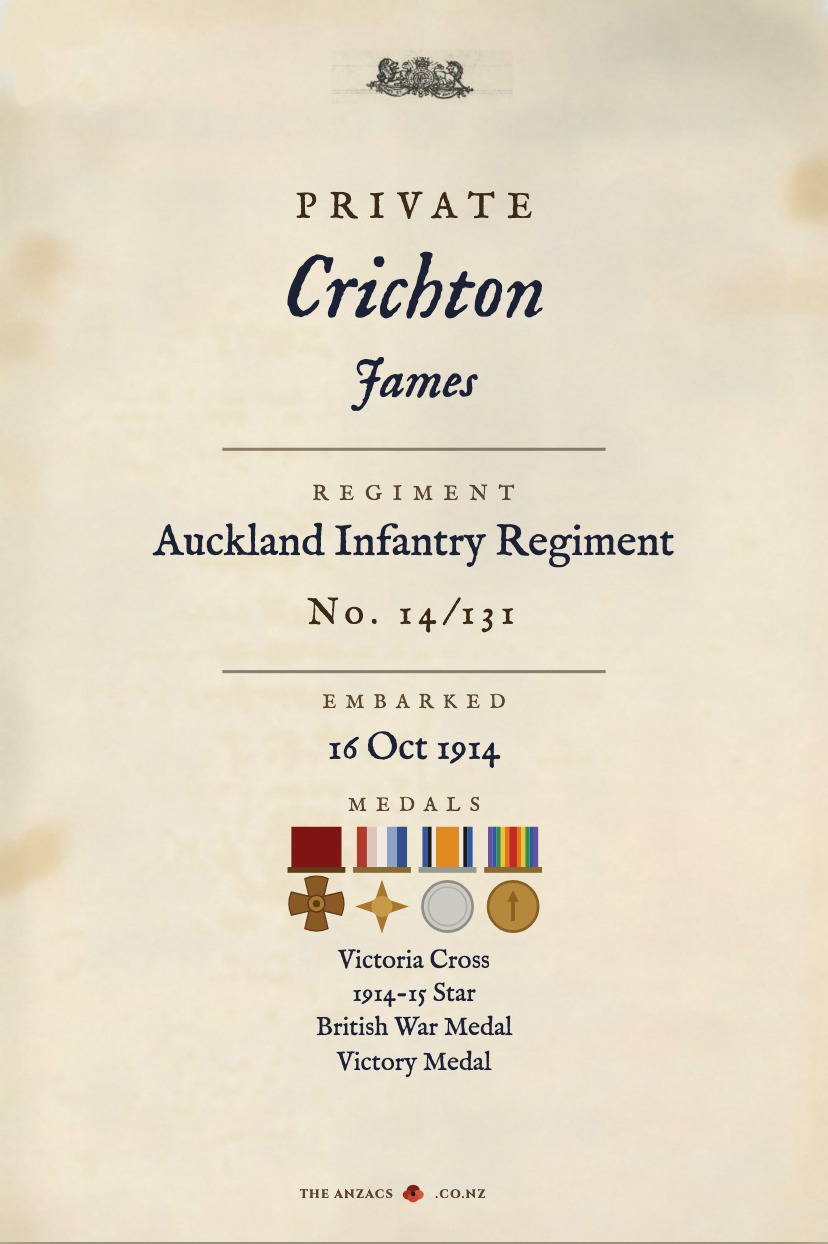
Private James Crichton VC
An Irish-born Auckland linesman who joined up at thirty-five, older than almost anyone around him, and spent more than three years as an army baker before giving up his warrant-officer’s rank to fight at the front. Wounded and cut off on the Scheldt River, he swam it under machine-gun fire to carry a message, then went back out to strip the fuses from German demolition charges on a bridge while snipers fired on him.
He is remembered today in three countries: New Zealand, Scotland, and the Ireland he left as a boy.
His story
-
Carrickfergus to Scotland
James Crichton was born on 15 July 1879 in Carrickfergus, County Antrim, Ireland. While he was still a boy the family moved to Northrigg, near Blackridge in West Lothian, Scotland, a mining district, and by ten he was working in the coal mines as his father had. He was nicknamed “Scotty” for the rest of his life, despite being Irish by birth.
Source: Wikipedia; Birkenhead RSA Medals. -
A soldier before the war
He enlisted in the Royal Scots in 1897, then transferred to the Queen’s Own Cameron Highlanders in 1899 and served through the Second Boer War in South Africa, present at the capture of Pretoria and the battles of Diamond Hill and Nooitgedacht, before his discharge around 1904.
Source: Wikipedia; Online Cenotaph. -
Auckland
He emigrated to New Zealand and settled in Auckland, working as a cable jointer and linesman for the Post and Telegraph Department, living at Boston Road, Mount Eden.
Source: NZHistory; Online Cenotaph. -
Enlisted at thirty-five
He enlisted in Auckland at thirty-five — notably old for a WWI volunteer — as a Driver in the New Zealand Army Service Corps.
Source: Online Cenotaph. -
Sailing on the Waimana
He embarked with the Main Body aboard HMNZT 12 Waimana, and was posted as a baker with the 1st New Zealand Field Bakery, which supplied bread to the whole force.
Source: Online Cenotaph. -
Three years as a baker
He served with the Field Bakery through the Gallipoli campaign and then in France and Belgium, rising steadily through Corporal, Quartermaster-Sergeant, and eventually Warrant Officer, Class Two.
Source: Wikipedia; NZHistory. -
He gave up his rank to fight
After more than three years behind the line, he chose to give up his warrant officer’s rank and re-mustered as a private in the 2nd Battalion, Auckland Infantry Regiment, to see front-line service before the war’s end — joining the battalion at the front in late August 1918.
Source: Wikipedia; NZHistory. -
The Scheldt at Crèvecoeur
During the advance toward the Hindenburg Line, his platoon rushed across an old stone bridge into Crèvecoeur and was cut off by a German counter-attack, coming under heavy machine-gun fire. Crichton, already wounded in the foot, volunteered to carry a report back to company headquarters — which meant swimming the river fully clothed and crossing open ground swept by fire. He made it, and made it back. He then discovered the Germans had mined the bridge for demolition, and on his own initiative went out again under fire from machine guns and snipers to remove the fuses and detonators, carrying them away with him to make the charges safe.
Source: London Gazette, Issue 31012; NZHistory. -
The Victoria Cross
The citation: “Though wounded in the foot, he continued with the advancing troops… When his platoon was subsequently forced back by a counter-attack he succeeded in carrying a message which involved swimming a river and crossing an area swept by machine-gun fire… Later he undertook on his own initiative to save a bridge which had been mined, and, though under close fire of machine-guns and snipers, he succeeded in removing the charges, returning with the fuses and detonators. Though suffering from a painful wound he displayed the highest degree of valour and devotion to duty.” — London Gazette
-
Buckingham Palace
King George V presented him with the VC in a joint investiture with fellow New Zealand recipients Reginald Judson, Harry Laurent and John Gildroy Grant. He returned to Auckland on 23 June 1919 to a civic reception at the Town Hall, and was formally discharged that September, no longer fit for service because of his wound.
Source: NZHistory; Online Cenotaph. -
Back to the linesman’s trade
He married Amy Watkins, a war widow, in 1919, and returned to his old trade with the Post and Telegraph Department in Auckland, working his way up to foreman before retiring in July 1939.
Source: Birkenhead RSA Medals; NZHistory.
Afterwards
He lived out his life in Takapuna, on Auckland’s North Shore, attending the 1937 coronation of King George VI as part of the New Zealand Coronation Contingent and, in 1956, the Victoria Cross centenary celebrations in London at the age of seventy-six. He died on 22 September 1961, aged 82, and his ashes were interred at Waikumete Cemetery. His family donated his Victoria Cross and campaign medals to the Auckland War Memorial Museum, where they remain. He is remembered on a plaque in Queens Gardens, Dunedin, by Crichton Place in Hastings, and — a century after he left as a boy — by a permanent memorial unveiled in the War Memorial Gardens of his birth town, Carrickfergus, in 2018.
His sign
Crichton is one of the eleven soldiers in The VC Gallery, our stock series honouring New Zealand’s First World War Victoria Cross recipients, on the same corflute sign we make every soldier’s record on.
Photograph
We haven’t hosted a photograph here
A 1920s portrait of him by Francis McCracken is held in the Archives New Zealand war art collection. Rather than copy someone else’s image onto our own site, we’d rather send you to see it where it’s properly held: his full record at the Auckland War Memorial Museum’s Online Cenotaph.
Sources
- James Crichton, Online Cenotaph, Auckland War Memorial Museum.
- James Crichton, Wikipedia.
- James Crichton, 1918, NZHistory.
- James Crichton VC, Birkenhead RSA Medals.
- London Gazette, Issue 31012, 15 November 1918.
A small number of details — his exact reason for transferring to the infantry so late in the war, and some of his later WWII-era service — vary between the sources we found. If you can help confirm them, we’d welcome it.