Victoria Cross · High Wood, the Somme · 1916
Sergeant Donald Brown VC
An Oamaru farmer who sold his land to go to war, and who on one September morning in 1916 rushed three German machine-gun posts, one of them alone. He was the second New Zealander awarded the Victoria Cross in the First World War, and the first to win it on the Western Front. Two weeks later, still in the same push, a sniper killed him.
He never married. His father accepted the medal in his place.
His story
-
Dunedin
Donald Forrester Brown was born on 23 February 1890 in Dunedin, the youngest of ten children of Robert Brown, a draper, and his wife Jessie, Scottish migrants. The family moved north to Oamaru while Donald was still small, where Robert built up a drapery business on Thames Street known as “the Polytechnic.”
Source: Wikipedia; Birkenhead RSA Medals. -
Oamaru and Waitaki
He went to South School and then Waitaki Boys’ High School, where he was known as a talented rugby player. Rather than joining the family shop, he took up farming, and by 1913 owned a mixed farm at Totara, just south of Oamaru, running cattle and hens and growing potatoes.
Source: Birkenhead RSA Medals; victoriacrossonline.co.uk. -
He sold the farm
A year into the war, at twenty-five, he sold his farm and enlisted in the New Zealand Expeditionary Force. He trained at Trentham and joined the 10th (North Otago) Company, 2nd Battalion, Otago Infantry Regiment.
Source: Online Cenotaph. -
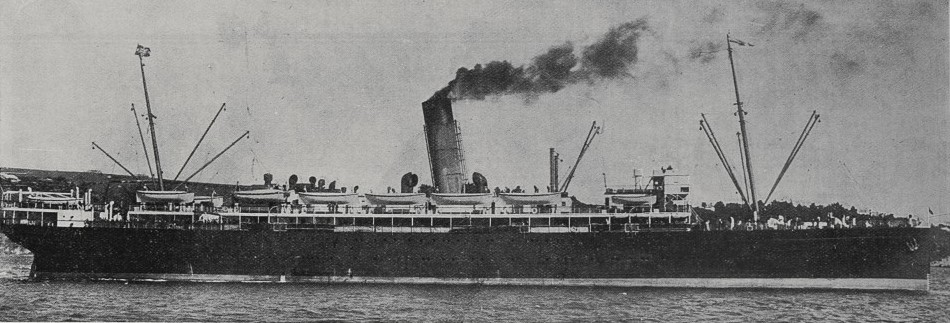
Sailing on the Maunganui
He embarked with the 9th Reinforcements aboard HMNZT 37 Maunganui, as a private, bound for Egypt.
Source: Online Cenotaph. -
Armentières, then the Somme
After training in Egypt his battalion reached France and was posted to the Armentières sector — a relatively quiet stretch of front used to blood new troops. By August 1916 he had been promoted sergeant, and that month his battalion moved south to the Somme, where the New Zealand Division was about to be committed to its first major battle.
Source: Wikipedia; Online Cenotaph. -
High Wood
On the opening day of the Battle of Flers-Courcelette, his company attacked German trenches south-east of High Wood. The first objective fell easily, but as they pushed on, flanking machine-gun fire cut the company from around 180 men to barely 57. Promised tanks never arrived. Twice, alongside a comrade, Brown went forward to within thirty yards of German machine guns, killing the crews and taking the guns. Then, on his own, he rushed a third gun single-handed, killed its crew, and captured it. His coolness under fire, soldiers said afterward, was what kept the rest of the company moving. The battalion took its objective by seven that morning, and Brown helped organise the digging-in of the new line.
Source: London Gazette citation, No. 30130; Wikipedia; victoriacrossonline.co.uk. -
The Victoria Cross
He was first recommended for a lesser award; his battalion’s officers pushed for it to be raised to the Victoria Cross, and it was gazetted in June 1917 — New Zealand’s second VC of the war, and the first won on the Western Front rather than at Gallipoli.
The citation: “For most conspicuous bravery and determination in attack… At great personal risk this N.C.O. advanced with a comrade and succeeded in reaching a point within 30 yds. of the enemy guns. Four of the gun crew were killed and the gun captured. Later, he again, with a comrade, dashed forward and silenced a second machine gun… when his comrades were dropping fast from the fire of a hidden machine gun, this N.C.O. rushed forward alone and attacked it with bombs, thereby saving the situation.” — London Gazette
-
Eaucourt l’Abbaye
He did not live to hear of the award. Just over two weeks after High Wood, in fighting near Eaucourt l’Abbaye, he attacked and silenced another German machine-gun post. While firing on retreating German troops afterward, he was shot and killed instantly by a sniper. He was twenty-six.
Source: Wikipedia; CWGC. -
Presented to his father
Because he never married and left no children, his Victoria Cross was presented to his father, Robert Brown, by the Governor-General, the Earl of Liverpool, at a ceremony in Oamaru.
Source: Wikipedia; Birkenhead RSA Medals.
Afterwards
He is buried at Warlencourt British Cemetery in the Somme, about three miles from Bapaume. His medal has stayed in the family, loaned over the years to Waitaki Boys’ High School, the QEII Army Memorial Museum at Waiouru, and the North Otago Museum in Oamaru. A memorial tablet was unveiled in the Oamaru Municipal Chambers in 1917, and memorial oak trees were planted around the town in 1919. He is also remembered on a plaque in Queens Gardens, Dunedin, and a memorial sundial at Caroline Bay, Timaru.
His great-nephew Bob Brown has kept the family’s memory of him alive, bringing the medal to reunions and contributing toward a planned bronze statue of him for North Otago. A collection of his wartime letters was published in 1998 under the title Your Loving Son, Don.
His ship
His sign
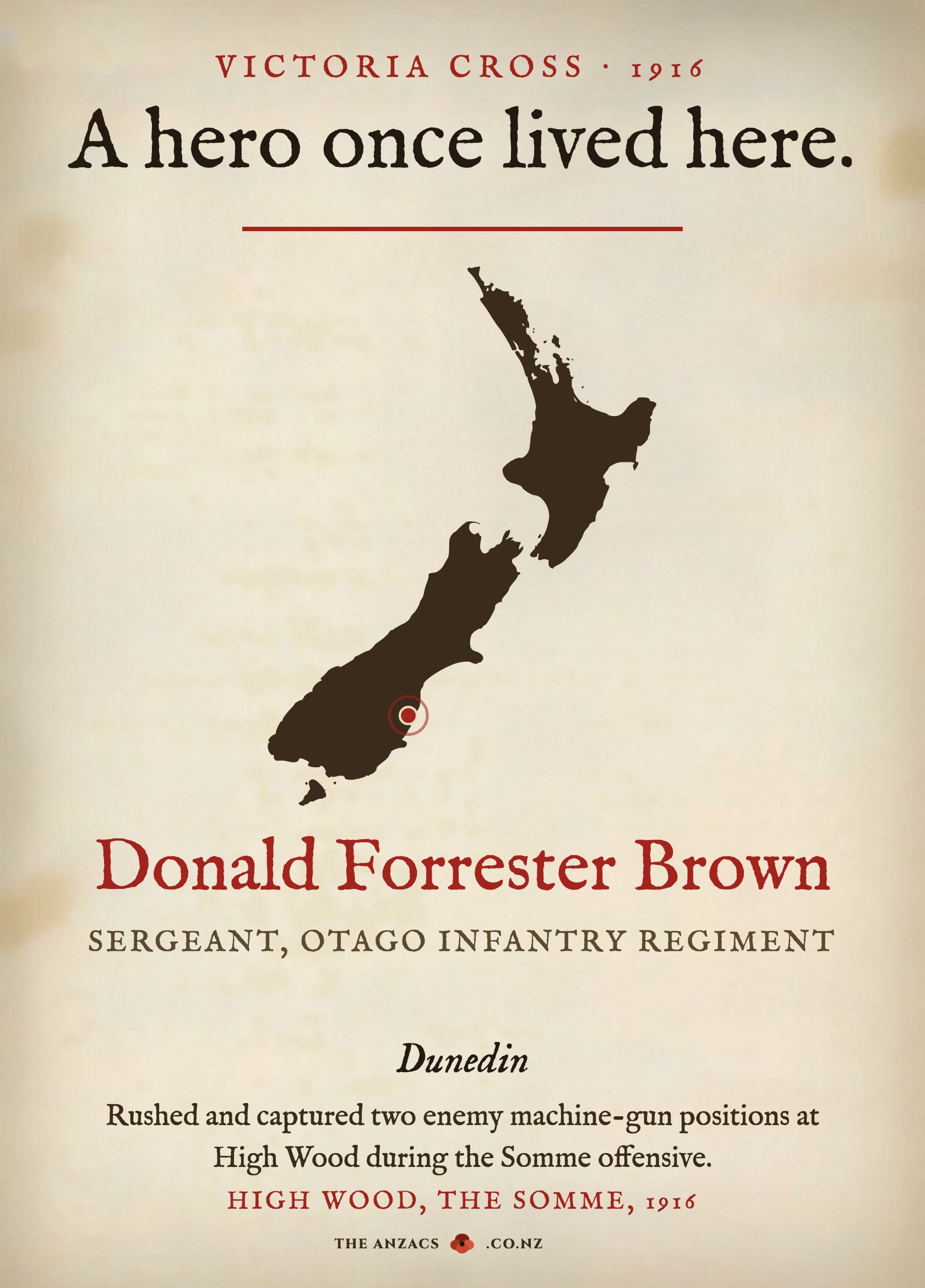
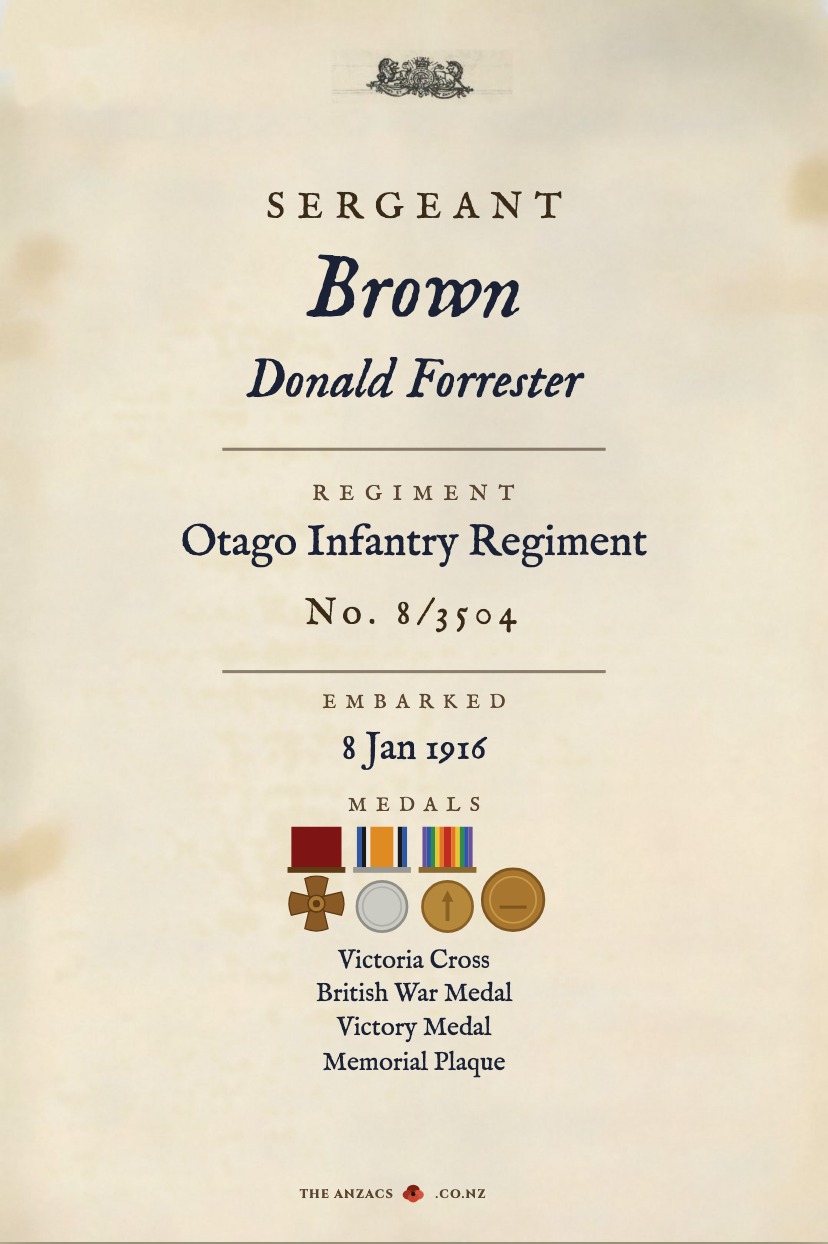
Brown is one of the eleven soldiers in The VC Gallery, our stock series honouring New Zealand’s First World War Victoria Cross recipients, on the same corflute sign we make every soldier’s record on.
Photograph
We haven’t hosted a photograph here
Rather than copy someone else’s image onto our own site, we’d rather send you to see it where it’s properly held: his full record, with photographs, at the Auckland War Memorial Museum’s Online Cenotaph, and his story at the Commonwealth War Graves Commission.
Sources
- Donald Forrester Brown, Online Cenotaph, Auckland War Memorial Museum.
- Donald Forrester Brown, Wikipedia.
- Donald Forrester Brown VC, Birkenhead RSA Medals.
- Donald Forrester Brown VC, Victoria Cross Online.
- Donald Forrester Brown, casualty record, and his story, Commonwealth War Graves Commission.
- New Zealand Victoria Cross recipients, NZHistory.
- Statue to honour VC war hero, Otago Daily Times.
A small number of details above — the exact date his VC was gazetted, and one or two family details from his early life in Oamaru — vary slightly between the sources we found. If you can help confirm them against a primary record, we’d welcome it.