Victoria Cross · Chunuk Bāir, Gallipoli · 1915
Corporal Cyril Bassett VC
A bank clerk from Mount Eden, barely five foot four, who spent the Battle of Chunuk Bāir running telephone wire across open ground in daylight, under fire that never really stopped. He is the only New Zealander awarded the Victoria Cross at Gallipoli — and to this day the only member of the NZ Corps of Signals ever to win one.
This is his story, as far as the records tell it: bank clerk, signaller, VC, husband, branch manager, lieutenant colonel, grandfather — and, by every account, a private man who never much liked the fuss.
His story
-
Mount Eden
Cyril Royston Guyton Bassett was born on 3 January 1892 in Mount Eden, Auckland, the only son of Frederick Charles Bassett, a printer, and Harriet Adelle Bassett (née Powley). He went to Grafton Public School, then Auckland Grammar School, then Auckland Technical College.
Source: Wikipedia; Online Cenotaph; Te Ara Dictionary of New Zealand Biography. -
The bank
At sixteen he became a clerk at the Newton branch of the National Bank of New Zealand in Auckland — the start of a banking career that, apart from two wars, would last the rest of his working life. Around 1909 he joined the Auckland College Rifles as a territorial volunteer, and by about 1911 had transferred to the Auckland Divisional Signal Company: the trade that would define his war.
Source: Te Ara; Online Cenotaph; Wikipedia. -
Enlisted
He enlisted in the New Zealand Expeditionary Force as a sapper in the Corps of New Zealand Engineers, posted to the New Zealand Divisional Signal Company. He was short even by the standards of the day — about five foot four — and it very nearly kept him out.
Source: contemporary NZEF enlistment accounts; Online Cenotaph. -
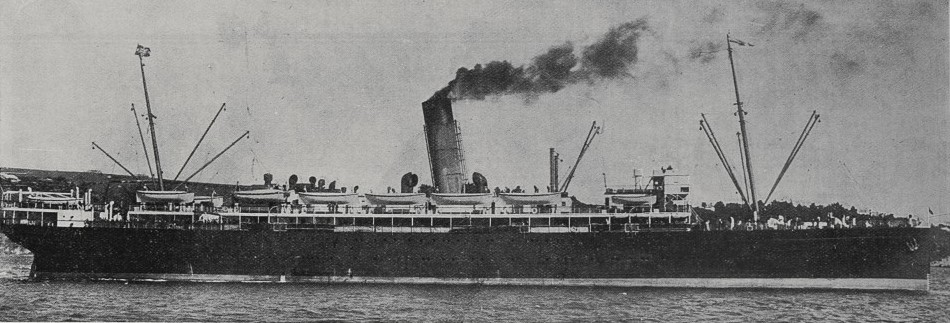
Sailing on the Maunganui
He embarked from New Zealand on 16 October 1914 aboard HMNZT 3 Maunganui, bound eventually for Egypt, where the newly raised New Zealand Expeditionary Force trained through the winter before Gallipoli.
Source: Online Cenotaph. -
Anzac Cove
He landed at Anzac Cove on the first day of the Gallipoli campaign. In the weeks that followed, the signallers of the New Zealand Divisional Signal Company kept telephone lines running between the front and headquarters — work that meant walking exposed ground, in daylight, again and again, to follow a wire back to wherever a shell had cut it. In early May, Bassett and two other signallers were already being noticed for laying wire under heavy fire.
Source: Ngā Tapuwae First World War Trails; NZHistory; Wikipedia. -
Chunuk Bāir
Before dawn on 8 August, the Wellington Infantry Battalion took the summit of Chunuk Bāir — the highest point New Zealand troops reached at Gallipoli. Holding it meant staying in contact with headquarters, and every line strung to the new position was cut by shellfire within hours, sometimes minutes. Now a corporal commanding a section of about five other signallers, Bassett went out again and again in full daylight to lay and repair the wire, the only way of keeping the forward troops in touch with their commanders. He carried a revolver and a bayonet, and was not hit, though his tunic was pierced twice and a bullet struck his boot. He was recommended for the Victoria Cross by Major Arthur Temperley at brigade headquarters.
Source: London Gazette citation, 15 October 1915; Online Cenotaph; Ngā Tapuwae First World War Trails; Wikipedia. The citation itself is dated 7 August; historians generally place the bulk of the wire-laying across 7–9 August, and NZHistory notes the gazette date as likely a small error. -
Evacuated
Like so many at Gallipoli, he was eventually brought down by illness rather than a wound — dysentery — and evacuated to convalesce in England.
Source: Wikipedia; Birkenhead RSA Medals. -
The Victoria Cross
His VC was gazetted in London. He remains the only member of the New Zealand Expeditionary Force awarded the Victoria Cross during the entire Gallipoli campaign, and to this day the only member of the New Zealand Corps of Signals ever to win one.
The citation: “For most conspicuous bravery and devotion to duty on the Chunuk Bair ridge in the Gallipoli Peninsula on 7th August, 1915. After the New Zealand Infantry Brigade had attacked and established itself on the ridge, Corporal Bassett, in full daylight and under a continuous and heavy fire, succeeded in laying a telephone line from the old position to the new one on Chunuk Bair. He has subsequently been brought to notice for further excellent and most gallant work connected with the repair of telephone lines by day and night under heavy fire.” — London Gazette, 15 October 1915
-
Buckingham Palace
King George V presented him with the Victoria Cross at Buckingham Palace. A photograph from the following day shows him outside the Palace, cheered on by a crowd of New Zealand soldiers.
Source: NZHistory (photograph); Wikipedia. -
The Western Front
He rejoined his unit and moved to France in June 1916, serving through the Somme with the New Zealand Division. He was commissioned Second Lieutenant in September 1917, and wounded twice — once that October, and again in March 1918, when a German artillery barrage during the Spring Offensive destroyed the New Zealand Rifle Brigade headquarters where he was serving as signals officer, killing Brigadier-General Harry Fulton. Bassett dug himself out and went straight back to restoring communications. He was recommended for the Military Cross for it; the recommendation was not granted.
Source: Wikipedia. This Western Front detail rests mainly on one source and would benefit from a check against his Archives New Zealand service file. -
Home
He returned to New Zealand as the Division demobilised in late 1918, and was formally discharged from the NZEF in 1919.
Source: Birkenhead RSA Medals. -
Back to the bank
He returned to the National Bank of New Zealand and to the Territorial Force, holding a lieutenant’s commission until he was placed on the retired list in 1929. His banking career took him to branches including Paeroa, and eventually to the Auckland Town Hall branch, where he would spend two decades as manager.
Source: Wikipedia; NZ Herald. -
Marriage
He married Ruth Louise Grant at St David’s Church, Grafton, Auckland. They had two daughters. One of them later said she only found out her father had won the Victoria Cross when her class studied the Gallipoli campaign at school — he had never mentioned it at home.
Source: Wikipedia; Find a Grave. -
The second war
Called up again for the Second World War, he served on the home front as a captain in the New Zealand Corps of Signals, was promoted major in 1942, and rose to lieutenant colonel as Commander of Signals, Northern Military District, before his discharge in December 1943. He returned to the National Military Reserve and formally retired from it in 1948.
Source: NZDF; Wikipedia; Birkenhead RSA Medals. -
Back to Gallipoli
He made a pilgrimage back to Gallipoli in 1948. The following Anzac Day, in 1949, he recorded a fifteen-minute talk about the visit for New Zealand radio — a recording that survives in the national sound archive today.
Source: Ngā Taonga Sound & Vision. -
Devonport
He retired from banking in 1952 and settled at Stanley Point, Devonport, on Auckland’s North Shore, where he lived for the next four decades. He served as a Justice of the Peace and stayed active in ex-service life — the Gallipoli Association, the Sappers Association, the King Empire Veterans Club, the Navy League. He sailed a keeler yacht he called the Lady Wilma, and played the violin.
Source: NZ Herald. -
Devonport
He died at Devonport, six days after his 91st birthday, survived by Ruth and their two daughters. At his funeral, the Very Rev Owen Baragwanath spoke of “a picture of heroism beyond the understanding of most of us” — and of a private man who, by every account, hated all the fuss. He was cremated and his ashes interred at North Shore Memorial Park, Auckland.
Source: NZ Herald; Find a Grave.
In his own words
“I was so short that the bullets just passed over me. I reckon there must be some guardian angel looking after me, especially as one man was shot dead in front of me and another wounded just behind.”
Cyril Bassett, on the fighting at Chunuk Bāir — quoted widely, including by the Birkenhead RSA and in New Zealand’s official war history.
Afterwards
His Victoria Cross and full medal group are held today at the Auckland War Memorial Museum, in the Hall of Memories, part of the Scars on the Heart First World War gallery. In 1984 his widow Ruth gave the Royal New Zealand Corps of Signals a memorial trophy in his name — a statue of him laying a line at Chunuk Bāir — awarded each year to the Corps’ most outstanding corporal, the rank he held when he won his VC. A lookout at Stanley Point, near the Devonport home where he lived for forty years, is named for him. And since 2009 secondary school students have competed in the National Bank (now ANZ) Cyril Bassett VC Speech Competition, with the national winner travelling to Gallipoli for Anzac Day.
In December 2023, the Royal New Zealand Corps of Signals presented his family — including his then 92-year-old daughter, Cherry Bramwell — with replica medal sets at a ceremony in the same Auckland Museum hall where his originals are kept.
His ship
His sign
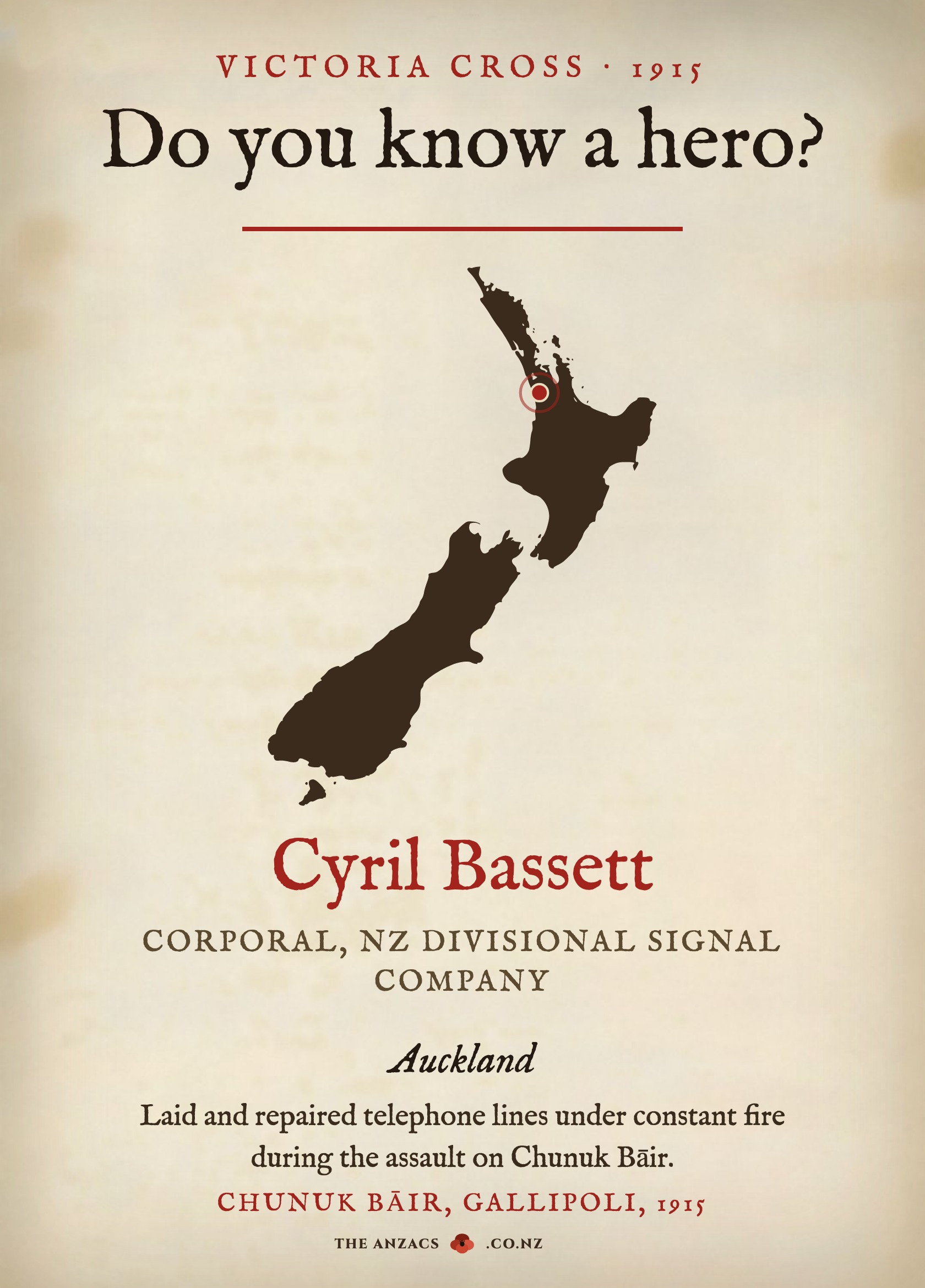
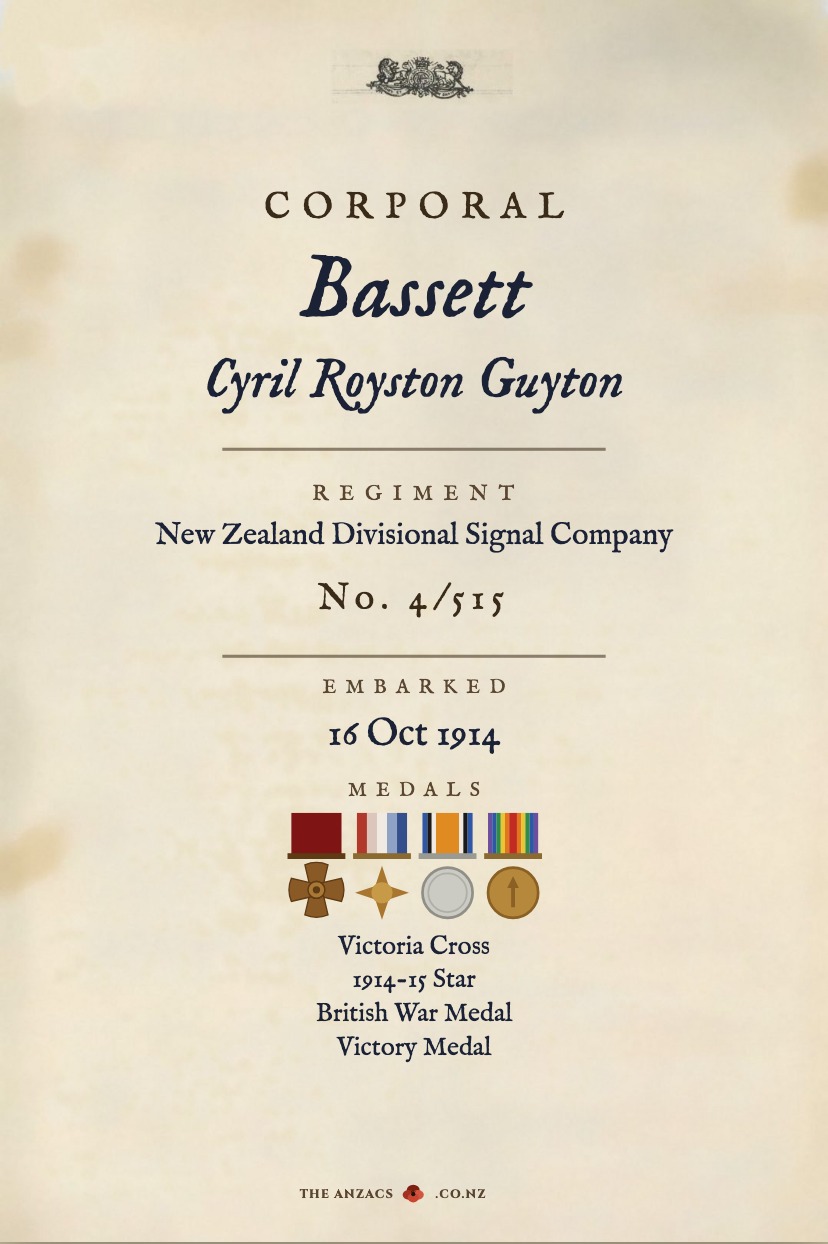
Bassett is the first design in The VC Gallery, our stock series honouring New Zealand’s First World War Victoria Cross recipients — his name, his Auckland home, and his Chunuk Bāir citation, on the same corflute sign we make every soldier’s record on.
Photograph
We haven’t hosted a photograph here
Cyril Bassett was photographed a number of times, including outside Buckingham Palace the day after his investiture. Rather than copy someone else’s image onto our own site, we’d rather send you to see it where it’s properly held: NZHistory’s photograph of Bassett outside Buckingham Palace, and his full record, with further photographs, at the Auckland War Memorial Museum’s Online Cenotaph.
Sources
- Cyril Royston Guyton Bassett, Online Cenotaph, Auckland War Memorial Museum.
- Cyril Bassett, Wikipedia.
- Bassett, Cyril Royston Guyton, Te Ara — the Encyclopedia of New Zealand.
- Sapper Cyril Bassett, Ngā Tapuwae First World War Trails.
- New Zealand Victoria Cross recipients, NZHistory; and photograph, Buckingham Palace, 4 February 1916.
- VC holder’s legacy cast for generations, New Zealand Defence Force, December 2023.
- Lookout a fitting memory for hero, New Zealand Herald.
- Cyril Bassett VC, Birkenhead RSA Medals.
- Cyril Bassett’s Victoria Cross, won at Gallipoli, Ngā Taonga Sound & Vision.
- Cyril Royston Guyton Bassett, Find a Grave.
- Cyril Royston Guyton Bassett, VC and GC Association.
A small number of details above — his Western Front Military Cross recommendation, and the exact date he enlisted — currently rest on a single secondary source rather than a primary record we’ve seen ourselves. If you can help confirm them against his Archives New Zealand file, we’d welcome it.