Victoria Cross · La Basse-Ville, Belgium · 1917
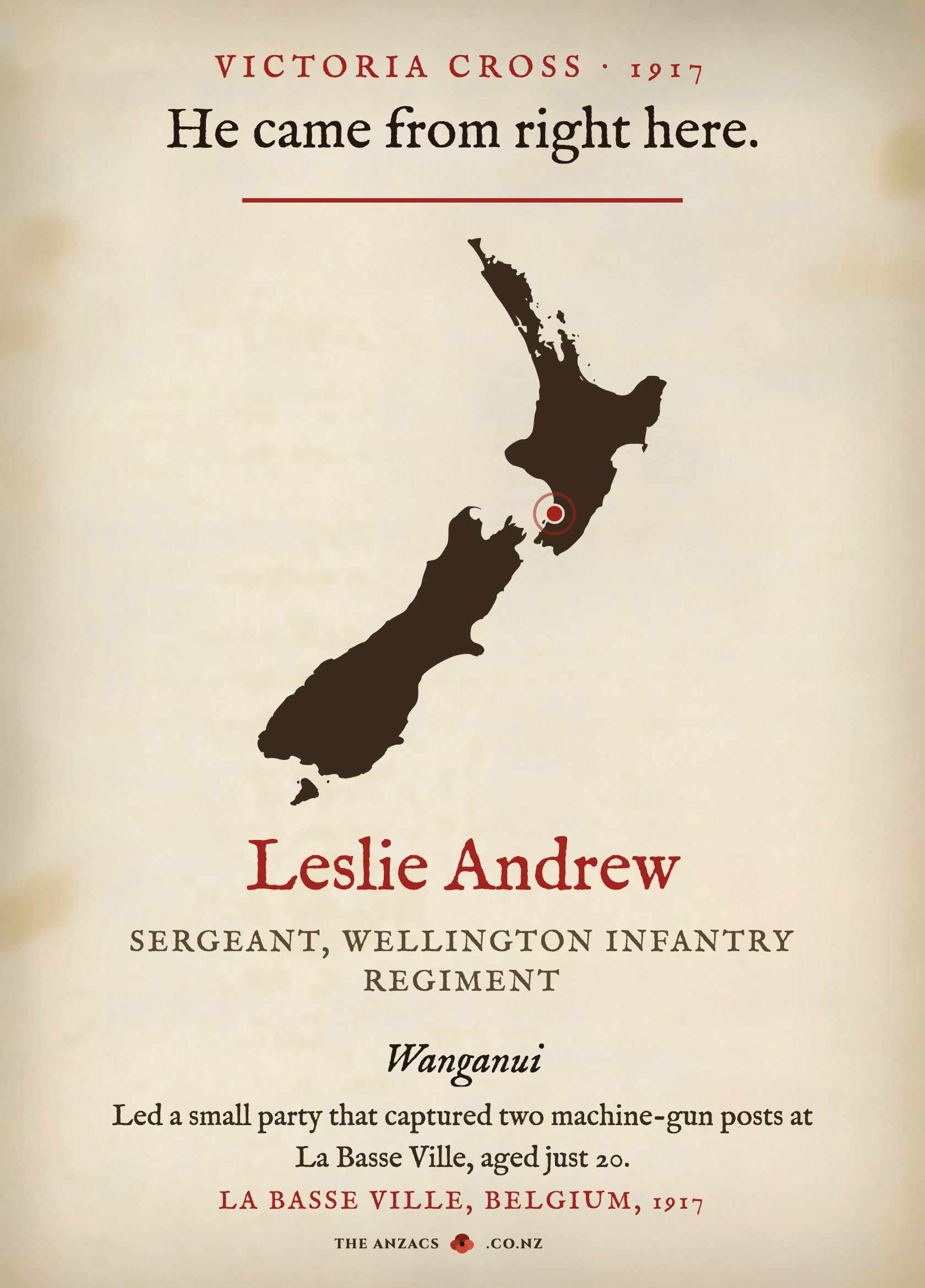
Sergeant Leslie Andrew VC, DSO
A twenty-year-old railway clerk from Wanganui, the youngest New Zealander to win the Victoria Cross in the First World War, who crawled through thistles to reach an unexpected German machine-gun post and captured it before pressing on to his own objective. He went on to make soldiering his life’s work, and by 1941 was a lieutenant-colonel commanding an entire battalion at the Battle of Crete.
The decision he made that day at Maleme is still argued over by historians. He finished the war a Brigadier.
His story
-
Ashhurst and Wanganui
Leslie Wilton Andrew was born on 23 March 1897 at Ashhurst, Manawatū, the son of William Jeffrey Andrew, a schoolteacher, and Frances Hannah Andrew. His father was later appointed headmaster of Wanganui East School, and the family moved there while Leslie was young, so although he was born in Ashhurst it is Wanganui he grew up and was schooled in. He worked in a solicitor’s office and then as a clerk with the New Zealand Railways Department in Wellington before the war.
Source: Wikipedia; Online Cenotaph; victoriacrossonline.co.uk. -
Enlisted at eighteen
He enlisted at eighteen, giving his age as twenty — the minimum required — to be accepted.
Source: Online Cenotaph; Wikipedia. -
Sailing on the Ulimaroa
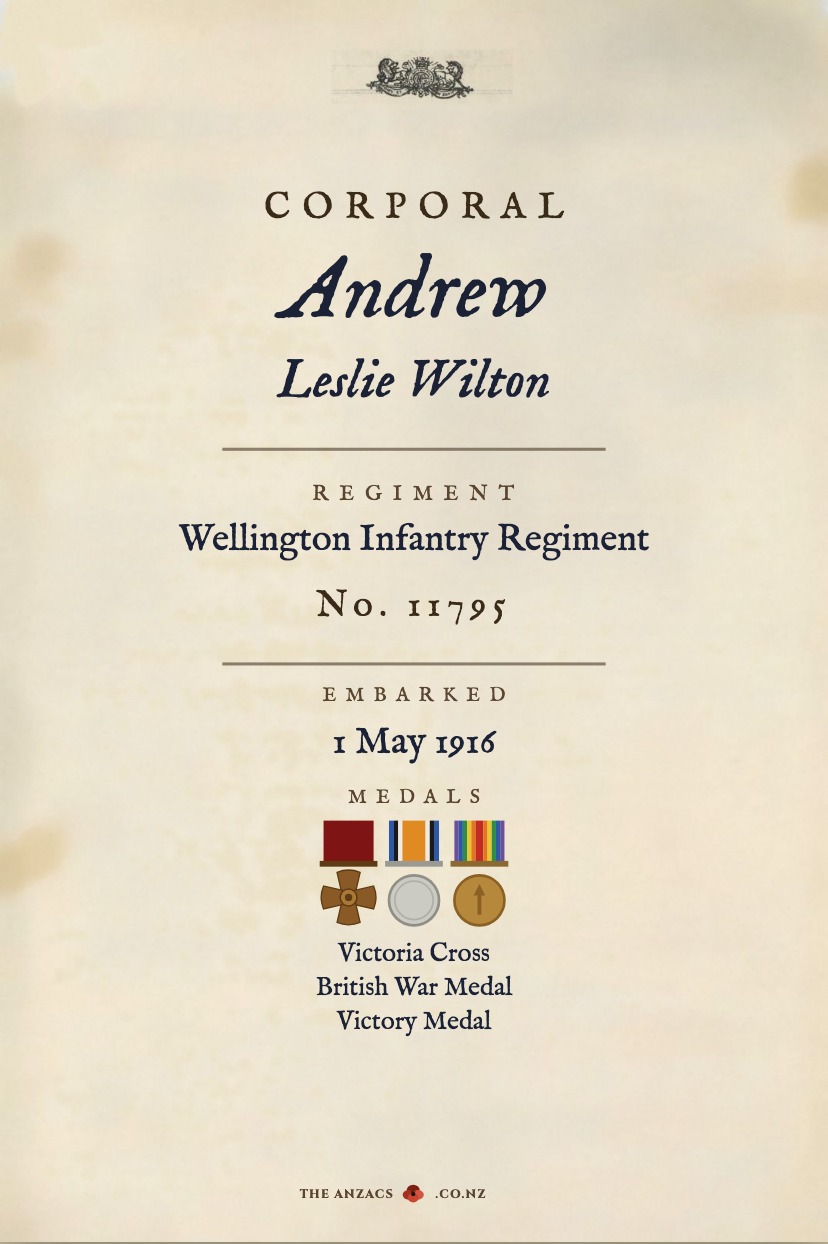
He embarked with the 12th Reinforcements, Wellington Infantry Battalion, aboard HMNZT 51 Ulimaroa, reaching Egypt that June before moving on to France in August.
Source: Online Cenotaph. -
The Somme and Messines
He was wounded during the Somme fighting in September 1916, promoted corporal in January 1917, and went on to serve at Messines that June and in the opening phase of the Passchendaele offensive.
Source: Wikipedia. -
La Basse-Ville
Leading a small party from the Wellington–West Coast Company against a garrisoned building beyond La Basse-Ville, Andrew found an unexpected German machine-gun post on a railway line, holding up another company entirely. He diverted his men, crawling through thistles to avoid being seen, attacked and captured the post, killing several of its crew. He then pushed on toward his own objective with Private L. R. Ritchie, advancing further to clear a second German position before withdrawing — at twenty, the youngest New Zealander to win the Victoria Cross in the war.
Source: London Gazette, No. 30272; National Army Museum. -
The Victoria Cross
The citation: “For most conspicuous bravery… unexampled for cool daring, initiative, and fine leadership.” — London Gazette. He was promoted sergeant the day after the action, and received his VC from King George V at Buckingham Palace on 31 October 1917.
-
Commissioned
He was commissioned Second Lieutenant on 1 March 1918, led a contingent through London’s Victory Day parade, and was discharged from the NZEF in October 1919 to return home.
Source: Wikipedia. -
A career soldier
He married Bessie Mead Ball, a VAD nurse, at Basford, Nottinghamshire, the day after the Armistice, and settled with her in Levin. Rather than return to civilian life, he took a permanent commission in the New Zealand Staff Corps, serving as Adjutant of the Taranaki Rifles, on exchange with the Highland Light Infantry in India, and by 1939 as a Major.
Source: Wikipedia; National Army Museum. -
Commanding 22 Battalion
Promoted to command the newly formed 22nd (Wellington) Battalion, 2nd New Zealand Expeditionary Force, he took the battalion through the Battle of Greece and then to Crete, where it held Point 107, the hill overlooking the critical Maleme airfield. On the opening day of the German airborne assault, Andrew was lightly wounded, lost communication with his forward companies, and had a request for reinforcement refused by his brigade commander. After a night counter-attack with two tanks failed, he withdrew the battalion from Point 107 — a decision that let the Germans secure the airfield, and one still debated by historians as one of the most consequential single command decisions of the Crete campaign. Most assessments since have placed the greater share of blame on the wider failures above him rather than on Andrew alone.
Source: Wikipedia; NZHistory. -
North Africa
During Operation Crusader, when his brigade headquarters was overrun and his brigadier taken prisoner, Andrew took temporary command of the entire 5th Infantry Brigade for around a fortnight, conducting a night march to link up with Indian forces and helping hold off German attempts to relieve the siege of Bardia. He was awarded the Distinguished Service Order for his leadership during this period.
Source: Wikipedia; 22battalion.org.nz. -
Colonel, then Brigadier
He returned to New Zealand in 1942, was promoted Colonel and given command of the Wellington Fortress Garrison for the rest of the war, then commanded the New Zealand Victory Contingent for the 1946 London Victory Parade. Promoted Brigadier in 1948 as Commandant of the Central Military District, he retired from the Army in 1952, reportedly declining more than one invitation to stand for Parliament.
Source: Wikipedia.
Afterwards
He died on 8 January 1969 following a brief illness at Palmerston North Hospital, aged 71, survived by Bessie and their four children, and was buried with full military honours at Levin Cemetery — a piece of German shrapnel, lodged in his throat since the First World War and never removed, buried with him. Andrew Barracks at Linton Military Camp is named for him, and his medals, including the VC and DSO, are held at the National Army Museum, Waiouru, where they were among nine Victoria Crosses stolen in a notorious 2007 raid and recovered within weeks. A plaque was unveiled at Wellington Railway Station in 2017, a hundred years after La Basse-Ville, honouring the railway clerk who became a Brigadier.
His sign
Andrew is one of the eleven soldiers in The VC Gallery, our stock series honouring New Zealand’s First World War Victoria Cross recipients, on the same corflute sign we make every soldier’s record on.
Photograph
We haven’t hosted a photograph here
Rather than copy someone else’s image onto our own site, we’d rather send you to see it where it’s properly held: his full record at the Auckland War Memorial Museum’s Online Cenotaph, and a wartime photograph at NZHistory.
Sources
- Leslie Wilton Andrew, Online Cenotaph, Auckland War Memorial Museum.
- Leslie Andrew, Wikipedia.
- Leslie Andrew, 22 Battalion Association.
- Railway worker who received VC in WWI honoured with plaque, RNZ.
- Leslie Andrew VC, NZHistory.
The precise account of his decision-making during the Battle of Crete is still discussed by historians, and some secondary details of his later career come from sources we could only partly verify. If you can help confirm them, we’d welcome it.